
November 16, 2026
Titanium Surface Finishing: Choosing Between Anodizing, PVD and DLC
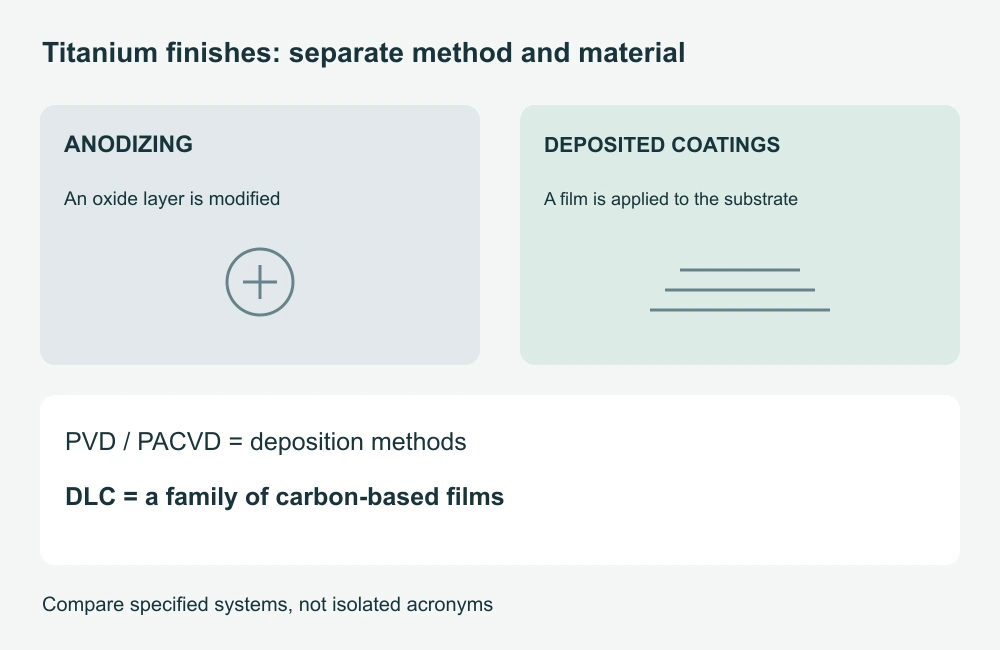
Choose a titanium finish by the job the surface must perform: appearance, identification, sliding contact, wear protection or a combination of these. Color anodizing changes the titanium oxide layer; PVD describes a deposition process; DLC describes a family of carbon-based coatings that can be deposited by different methods. They are not three interchangeable treatments or three completely separate categories.
A blue titanium component, a gold-colored link and a black housing can look convincing in photographs while leaving the important manufacturing questions unanswered. The image does not identify the treatment, coating system, thickness, adhesion or performance in service. A useful specification connects the desired result to a defined surface, a feasible route and a method of acceptance.

Start with the required surface function
Before choosing a process name, describe what the surface contacts, how it moves, what environment it encounters and which faces are visible. A stationary decorative face and a repeatedly sliding interface need different evidence. A finish selected only from a color chart may satisfy one task while doing little for the other.
Separate essential requirements from preferences. Color matching may be critical for adjacent components, while a hidden face only needs an agreed clean condition. A bearing interface may need a defined wear or friction test even when its appearance is unimportant. This separation gives the finishing specialist room to propose a suitable solution without weakening the functional specification.
| Option | What the name describes | Question to resolve |
|---|---|---|
| Color anodizing | An electrochemically modified titanium oxide layer | Can the required appearance be repeated on the actual substrate and texture? |
| Functional anodizing | A specified oxide treatment for an application | Which process and performance requirement apply? |
| PVD coating | A physical vapor deposition route | Which coating composition and layer system will be deposited? |
| DLC coating | A family of diamond-like carbon films | Which DLC system, deposition route and service conditions are intended? |
There is no useful universal ranking from “basic” to “best.” Compare candidates against the same part, preparation, exposure and acceptance criteria. If the purpose is merely to label sizes by color, a sophisticated sliding-contact coating may add complexity without solving a real problem.
What color anodizing does to titanium
Titanium Finishing Company describes color anodizing as an electrochemical modification of the natural oxide, producing colors through optical effects rather than added dyes. This is a different starting point from assuming that every anodized metal uses the same coloring system. Its titanium color-anodizing explanation supports that distinction.
For specification purposes, ask for a sample made from the actual grade and intended surface preparation. A brushed surface, a polished surface and a matte surface can present the same nominal color differently. The approval should identify both the color reference and the underlying texture instead of treating one as a substitute for the other.
Do not turn a supplier’s color repeatability statement into an unrestricted promise for every geometry, alloy or production route. Agree the comparison method for the project. If pieces are assembled side by side, review them together. If a curved part changes appearance with viewing angle, include representative viewing conditions in the acceptance discussion.
A voltage-to-color chart can be a process-development aid for its stated conditions, but it is not a finished-product specification on its own. The customer normally needs an approved appearance and controlled result; the specialist determines and maintains the process that achieves it. Avoid copying online voltage settings into a purchase order as though they guarantee a universal shade.
Functional anodizing needs a named requirement
Functional titanium anodizing should not be treated as color anodizing with a stronger marketing description. Titanium Finishing Company distinguishes several proprietary functional processes and lists specifications including AMS2488 Type II. Different variants have different stated characteristics, so the correct question is which defined treatment fits the intended application. See its functional titanium anodizing overview.
If an existing drawing calls out a standard, confirm its applicable revision, type and acceptance provisions with the design owner and processor. Do not replace that callout with a generic “gray anodize” instruction. Conversely, a gray appearance by itself does not prove compliance with a named functional specification.
Describe the contact condition that motivates the choice. A threaded assembly, a sliding contact and a decorative cover present different questions. If the goal is to reduce galling, explain the mating material, motion, loading and lubrication conditions so that the proposed treatment can be assessed in context.
A supplier’s dimensional statement for one proprietary process must not be generalized to every oxide treatment. Ask how the specific route affects the critical features, what must be masked, and how the finished dimensions will be verified. The approved process and drawing should remain connected throughout sampling and repeat orders.
PVD is a process family, not a complete finish specification
Physical vapor deposition can produce coatings with different compositions and layer architectures. Ionbond describes sputtering and cathodic arc among the methods used and explains that substrate preparation, deposition conditions and coating choice affect the result. Its PVD technology page is a useful starting point for understanding why “PVD” alone is incomplete.
For a quotation, identify the desired coating system or the performance requirement that the specialist must meet. Ask which layers, preparation and thickness range are proposed for the actual titanium substrate. A generic color such as black or gold does not answer those questions. Two visually similar deposits can have different intended applications.
Check the complete component’s compatibility with the proposed cycle. The relevant question is not merely whether titanium can tolerate a particular temperature, but whether the material condition, assembled parts, dimensional requirements and prior treatments remain suitable. Obtain the processor’s actual cycle limits instead of assuming all PVD processes run at one temperature.
Small features also affect coverage. Discuss recesses, holes, contact points and fixture orientation with the coater. A flat demonstration coupon cannot by itself establish uniform treatment throughout a complex component. The drawing should identify where coating coverage is required, where it is prohibited and where a documented transition is acceptable.
DLC identifies the coating family, not one deposition method
DLC means diamond-like carbon. Ionbond describes it as a group of carbon-based coatings and notes that DLC films may be applied through PVD or plasma-assisted chemical vapor deposition, PACVD. Therefore “PVD versus DLC” is often a comparison between a manufacturing route and a material family. It should be rewritten into a comparison of actual coating systems. See Ionbond’s DLC explanation.
The practical consequence is that a buyer should request more than the letters DLC. Identify the proposed film system, substrate preparation, intermediate layers where used, thickness and application limits. A low-friction or wear claim must be evaluated with the relevant counterface, motion, load, lubrication and environment, rather than assumed from a black appearance.
Different DLC families can prioritize different properties. Do not compare isolated hardness values without checking the test method and the complete coating-substrate system. A thin hard film does not make the underlying component infinitely rigid, nor does it remove the need to design a suitable contact geometry.
For a decorative titanium item, distinguish the desired black tone and gloss from the functional test requirement. For a sliding component, establish what counts as unacceptable wear, friction change or damage. A coating can meet an appearance reference while failing a functional target, or perform adequately while differing from an unapproved cosmetic expectation.
The finish starts before the finishing operation
The delivered surface reflects the substrate as well as the treatment. Machining marks, edge preparation, polishing direction and local geometry need to be resolved in the route. Do not assume that applying a thin film will conceal a poorly specified or inconsistent starting surface. Agree the condition in which parts enter the finishing operation.
Cleaning is part of that preparation. Ionbond’s PACVD guidance emphasizes the removal of foreign matter and the importance of cleaning to adhesion. The appropriate process must be selected by the specialist for the actual materials and contamination. Its PACVD technology guidance also explains why deposition and masking requirements vary by route.
Separate texture from roughness and gloss. “Brushed” describes an appearance direction but does not establish every surface parameter. “Mirror” is not a dimensional acceptance method. Mark visible faces and critical interfaces so that polishing or blasting does not unintentionally alter an edge, a fit or a functional contact.
For repeatability, retain the approved pre-treatment condition as well as the final sample. If a later batch changes from one machining or polishing route to another, assess whether the original finish approval still represents it. Otherwise, the finishing supplier may receive a different surface while being asked to reproduce an unchanged visual result.
Account for thickness where it affects fit
A deposited coating can change dimensions even when the layer is thin. Identify which tolerances apply before treatment and which apply to the delivered component. The drawing should not leave the machinist and coater to infer incompatible interpretations of the same nominal size.
For a simple geometric illustration, suppose a uniform deposited film adds thickness t to both sides of a diameter. An external diameter increases by approximately 2t, while an internally coated diameter decreases by approximately 2t. If t were 3 micrometers, the idealized diameter change would be 6 micrometers. This is a calculation example, not a specified thickness or measured result for a KeepWin coating.
The example assumes uniform deposition on the relevant surfaces and ignores preparation removal, local variation and other process effects. It must not be applied blindly to oxide growth, whose dimensional effect depends on the actual treatment, or to a masked and partially coated feature. Ask the processor to confirm the relevant final geometry.
Pay particular attention to press fits, locating holes, threads, sliding clearances and stacked components. A small change can matter when the original clearance is small. That does not mean every surface needs an extremely tight film-thickness tolerance; it means the critical interfaces must be identified and assessed deliberately.
Define where thickness is measured, by which method and on what representative geometry. A witness coupon can provide useful process evidence, but its relationship to recessed or differently oriented features on the actual part needs justification. Keep the acceptance plan tied to the features that determine function.
Specify masking, contact marks and coverage boundaries
Masking is an engineering requirement when some areas must remain untreated. Identify the face or feature, the required boundary and the reason: fit, electrical contact, bonding, assembly or appearance. A sentence saying “mask critical areas” gives the processor no reliable way to know where those areas are.
Also discuss how the part is held or contacted during treatment. Necessary fixture contact can leave a region with different coverage or a visible mark. Agree permitted contact locations before approving samples, especially when almost every external face is cosmetic. Moving the contact to a hidden surface may require a different fixture and should be reviewed rather than assumed.
Consider tolerance at the masking transition. A perfect mathematical boundary on a model may not describe the practical transition achievable on the real component. Ask for the proposed method and inspect representative samples. If a transition is unacceptable anywhere near a seal or a visible edge, the design may need a clearer treatment boundary.
For mixed-material assemblies, decide whether parts are treated separately before assembly. Adhesives, polymers, trapped fluids and hardware may not be compatible with the treatment cycle. The route needs confirmation for the complete assembly, not only for the exposed titanium face that the customer wants to color.
Evaluate wear and friction as a system
Wear is not a single property that can be predicted from a coating name. The contact pair, contact pressure, motion, contamination, lubrication and environment influence the outcome. Describe the actual duty and the failure that matters: visible scratching, rising friction, loss of fit, coating breakthrough or another defined event.
Oerlikon Balzers discusses coating selection for precision components in relation to load, motion and operating conditions. Its examples show why a technical coating recommendation belongs to an application rather than to a universal durability ranking. The technical article on coatings for precision components provides relevant context.
Choose a test that represents the intended decision. A scratch demonstration may help illustrate a visible response, but it does not automatically predict service life under repeated sliding. A bench wear result also needs its load, counterface and conditions documented before it can support comparison with another result.
Hardness is useful information when measured and reported appropriately, but it is not synonymous with adhesion, toughness, wear life or resistance to every scratch. Avoid choosing a film solely because one data-sheet number is larger. Ask whether the proposed coating-substrate combination addresses the actual failure mechanism.
Do not describe a finish as scratch-proof or permanently maintenance-free. Define acceptable wear and care conditions for the application instead. For parts that contact skin or regulated environments, any required compliance or biological assessment must be separately established; a generic coating name is not a product certification.
Approve appearance under repeatable conditions
Use a physical reference when appearance matters. Record its identity, material, preparation and treatment, and keep it linked to the drawing revision. A photograph is useful for identifying the sample, but screens, lighting and image processing make it an unreliable sole basis for exact color acceptance.
Agree the viewing environment, distance, orientation and which faces are assessed. Brushing direction and curvature can change perceived brightness. Compare assembled neighboring parts when their match matters, rather than accepting each separately under unrelated lighting. Specify whether small differences between surfaces are permissible.
If instrumental color or gloss measurement is required, agree the method, geometry, locations and acceptance criteria with a qualified provider. An unsupported numerical tolerance copied from another product can be difficult or meaningless to apply to a small curved face. A method needs to fit the geometry and the decision.
Keep cosmetic and functional approval separate. An inspector should be able to record “appearance accepted, fit unresolved” without forcing an all-or-nothing statement. This helps prevent an attractive sample from becoming accidental approval of a coating system that has not completed its required performance checks.
Build a sample and inspection plan that can resolve uncertainty
Before ordering samples, list the questions still open. Typical examples are color consistency across a contoured part, coverage inside a feature, final fit after deposition, and performance of the actual contact pair. Then connect each question to a sample configuration and a check. Producing several attractive parts without a decision plan may leave the main uncertainties untouched.
| Decision | Useful evidence | Insufficient substitute |
|---|---|---|
| Appearance | Agreed physical reference and viewing procedure | An uncontrolled screen image |
| Fit | Finished dimensions and relevant assembly check | Dimensions measured only before treatment |
| Coverage | Inspection at specified faces and transitions | A flat coupon without geometric justification |
| Wear behavior | Test with documented contact and exposure conditions | A generic hardness claim |
| Repeatability | Traceable samples from the agreed process | One unidentified showcase sample |
Agree who evaluates each result and what happens if it is inconclusive. A sample may reveal that the desired boundary cannot be held reliably, that a mating clearance is insufficient, or that the selected visual reference does not suit the substrate. Returning to the design is then a legitimate outcome, not a reason to conceal the limitation.
Do not invent a test certificate or imply that a generic illustration represents measured evidence. Actual results should identify the sample, method and conditions. If no performance test has been commissioned, describe the treatment as proposed or appearance-approved rather than proven for the intended duty.
Keep the sample matrix small but informative
A useful sample matrix changes the factors that the team actually needs to compare. If uncertainty concerns texture, compare the agreed texture alternatives while keeping the substrate and treatment basis consistent. If it concerns the coating system, use comparable preparation and geometry where practical. Changing every variable at once may produce an attractive winner without showing which decision made it successful.
Label each sample with a traceable identifier outside the evaluated area. The accompanying record should name the material, drawing revision, preparation, proposed finish and checks performed. Preserve the identity through photography, measurement and assembly review. A tray of visually similar samples can become difficult to interpret if the only identification was a temporary note that separated from the parts.
Where geometry limits direct measurement, agree how supporting evidence will be obtained. A sectioned sample, witness piece or other method may be appropriate for a particular question, but the relationship to the production part needs explanation. Do not accept a convenient measurement location as representative of an inaccessible critical region without discussing that assumption.
Record both acceptable and unacceptable observations. For example, a color match may be accepted while a contact mark must move, or a fit may be satisfactory while coverage at a recess needs further work. Assign the next action to the responsible party and identify whether another sample is required. This is more actionable than a general statement that the finish needs improvement.
After approval, retain a controlled reference and a readable approval record. Clarify whether the reference represents a target, a limit sample or an example within an acceptable range. Those meanings are different: a target suggests a preferred appearance, while a limit sample defines an acceptance boundary. Avoid relying on an unlabeled sample to communicate both.
Inspect representative delivered parts against the agreed requirements, rather than assuming that a successful development coupon guarantees every production component. The amount and frequency of inspection should match the risk and the contract. This article does not impose a universal sample size; the responsible parties must select and document an appropriate plan.
If the project later changes grade, geometry, substrate preparation or processing supplier, review the affected approvals before assuming continuity. A change may be harmless for one requirement but significant for another. The review should explain which evidence remains valid, which needs confirmation and whether the physical reference must be replaced.
Include rework, repeat orders and cost in the decision
Ask what happens if a sample fails. Removal and reapplication may affect dimensions, surface preparation or the permitted number of rework cycles. The processor must assess whether the specific substrate and finish can be reworked. Do not assume that every colored or coated titanium part can simply be returned to its original condition.
For a repeated product, preserve the approved coating designation, substrate grade, preparation, masking drawing and reference sample. A supplier or process change may require renewed approval even if the requested color name remains unchanged. The objective is to retain a reproducible specification rather than rely on a verbal description such as “the same black as last time.”
Compare quotations on equivalent scope. Preparation, masking, special fixtures, minimum batch charges, inspection and sample development can all affect the commercial proposal. A low treatment price may omit a surface-preparation step that another proposal includes. Separate one-time development from recurring processing when evaluating the intended volume.
There is no honest universal price order among anodizing, PVD and DLC without specifying the component and route. A simple geometry with a standard treatment can behave very differently from a small batch requiring complex masking and special checks. Seek an explanation of the cost drivers instead of a generic claim that one acronym is always cheaper.
Three examples of choosing the right questions
A colored titanium link
For a hypothetical link whose primary goal is appearance, begin with substrate grade, texture, color reference and assembled visual match. Review contact marks and edges that may rub against neighboring components. A color-anodizing sample may answer the appearance question, but it does not automatically demonstrate the desired wear behavior. A different coating system can be considered if the actual duty requires it.
A black instrument housing
Separate the visible outside faces from locating holes, gasket surfaces and any required electrical contacts. Ask for a specific proposed black coating system, compatible preparation and defined masking. Check the delivered fit and appearance after treatment. Choosing “DLC” in the drawing title does not remove the need for those details.
A titanium sliding component
Begin with the mating material, motion, load, lubrication and environment. Evaluate the proposed functional anodize or deposited coating against an agreed test and failure criterion. The most visually attractive option may not be the relevant one. These are planning examples, not descriptions of KeepWin production trials or promises that every route is available for every component.
The common principle is to make the requirement narrow enough to be checked. If several goals conflict, rank them and ask the specialist to identify the tradeoff. A documented compromise is preferable to an undefined finish expected to deliver every possible benefit.
Frequently asked questions about titanium finishes
Is DLC always better than PVD?
The question mixes a coating family with a process family. Some DLC systems use PVD, while others use PACVD. Compare named coating systems for the actual application, including preparation, substrate, thickness and test conditions.
Does a black titanium part prove that it has a DLC coating?
No. Appearance cannot identify the chemistry or deposition route. Request the agreed coating specification and appropriate process documentation. The same caution applies to identifying an anodizing treatment from a colored photograph.
Does anodizing remove the need to inspect dimensions?
No. Determine the dimensional effect of the specified treatment and verify the final requirements where relevant. Do not apply a statement about one proprietary oxide process to every anodizing route.
Can one finish specification cover every material in an assembly?
Not automatically. Each substrate and assembled element needs compatibility review. The process, appearance and acceptance method may differ between titanium, stainless steel, polymers and other materials, even when the target visual style is similar.
Specify a titanium finishing project with KeepWin
KeepWin’s titanium designs can be discussed with Grade 2 or Grade 5 material options. Confirm which components use the selected grade and keep that decision separate from the surface treatment. The titanium grade-selection guide explains the material comparison, while the titanium watch-band collection provides product-design references without proving a particular coating route.
For a non-watch component, provide the drawing, material, quantity, visible and functional faces, final dimensions and intended exposure. Include an appearance reference where needed. Our surface-finish reference guide can help organize that information, and the parts manufacturing inquiry starts the project review.
The written proposal should identify the actual finishing route and responsible processing scope before it becomes a supply commitment. Manufacturer sources cited here explain available technologies and general engineering considerations; they do not establish that a particular KeepWin item already uses that process or has passed a specified performance test.