
Functional surfaces
Identify mating, sealing, electrical or sliding faces. Define the required delivered condition and any measured surface parameter.
PARTNER-SUPPORTED MANUFACTURING / FINISH
Connect the surface treatment to the part’s function. KeepWin helps review material compatibility, appearance, protected faces and final-state dimensions so the finish is part of the project plan rather than an afterthought.
Available finishes, substrates, treatment specifications, masking and responsible operations require project confirmation. Illustrative samples do not establish exact color, measured roughness or universal process availability.
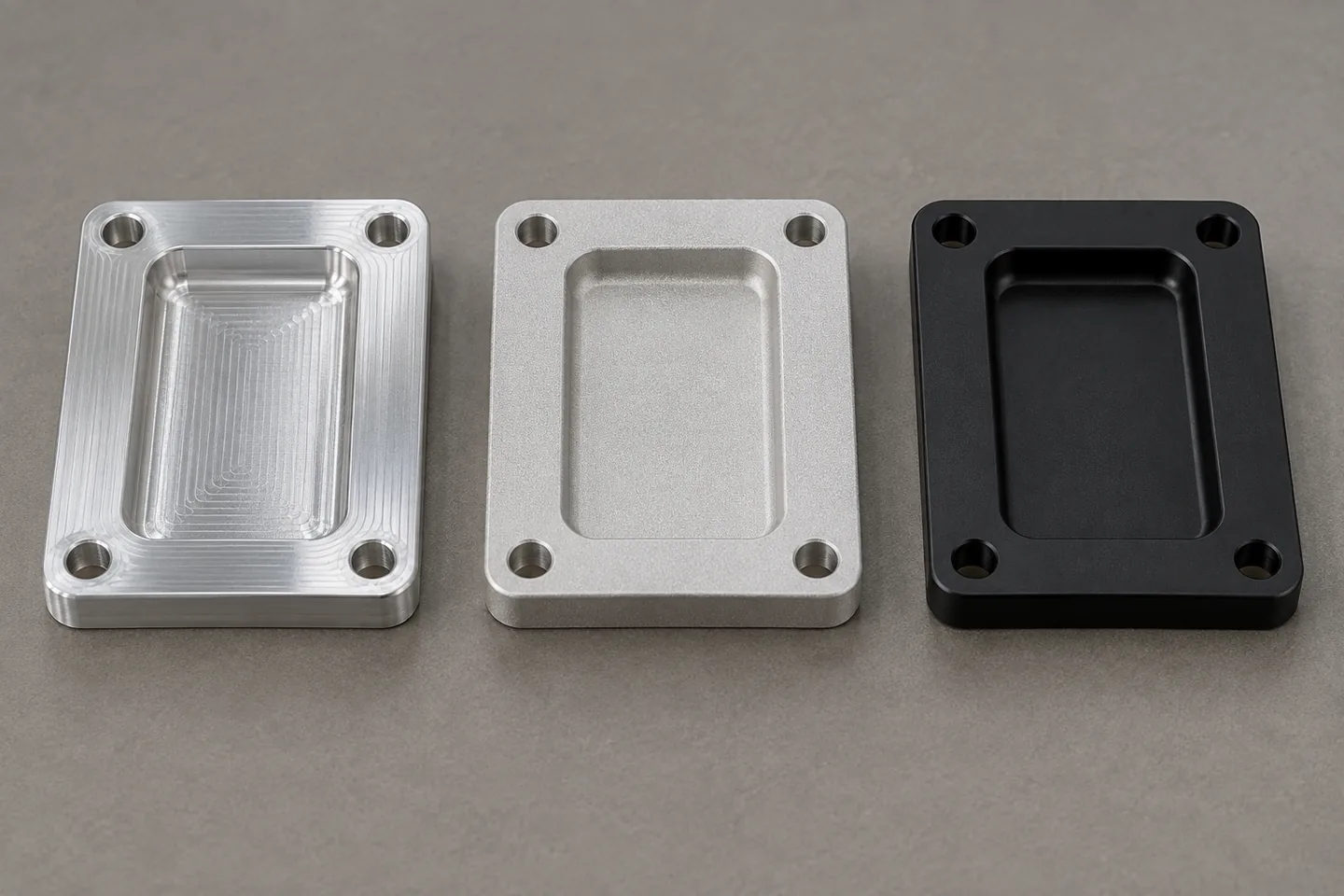
Generated appearance examples: as-machined, matte blasted and black anodized plates. They are not actual quotation samples, color standards or evidence that every material can receive these treatments.
01 / FINISH PURPOSE
Texture, color, corrosion-related requirements, conductivity and mating fit can pull treatment choices in different directions. Specify the function and evidence before selecting a broad finish name.
Identify mating, sealing, electrical or sliding faces. Define the required delivered condition and any measured surface parameter.
Mark cosmetic faces and appearance references. Agree texture direction, color comparison and permitted process traces under defined conditions.
Identify holes, threads, datums or contacts that must preserve a requirement. Discuss masking or another suitable route without assuming it is universally available.
02 / OPTION COMPARISON
Machining marks, mechanical finishing and surface treatments differ in what they do to the substrate. Compatibility and final results depend on the exact material and responsible process.
| Route | What to review | Do not assume |
|---|---|---|
| As-machined and edge treatment | Tool marks, burr condition and the edge requirements. | A uniform cosmetic texture or undefined roughness guarantee. |
| Blasting / brushing / polishing | Texture, direction, material removal and protected features. | No dimensional effect or an exact appearance from a screen image. |
| Anodizing or conversion treatment | Compatible substrate, specification, appearance and contact surfaces. | Every alloy is eligible or the result is an exact color standard. |
| Plating / coating | Substrate preparation, layer scope, fits and any required performance evidence. | Universal availability, a fixed thickness or automatic durability certification. |
03 / DIMENSIONAL EFFECTS
Material removal, added layers or converted surfaces can change a fit or edge. The treatment sequence should preserve the delivered requirement, not only the pre-finish geometry.
State whether the requirement applies before or after the relevant treatment. Review allowances or another suitable approach for controlled fits.
Identify functional engagement and any protected areas. Agree whether final-state gauging or assembly review follows the treatment.
Mechanical finishing can change edges and small details. Define which geometry and surface boundaries must remain functional.
Mark the scope and reason for a protected face. Available masking, setup and process sequence require confirmation for the responsible route.
04 / APPEARANCE REFERENCE
Lighting, angle, geometry and substrate can change how a finish looks. A digital image is useful for direction but not a complete acceptance standard.
| Feature | Define | Sample question |
|---|---|---|
| Texture | Direction, visible-area scope and reference. | Are adjacent faces and treatment transitions consistent with the intent? |
| Color | Physical reference or agreed specification and permitted variation. | Does the actual substrate and geometry meet the agreed comparison? |
| Marks | Permitted process traces and unacceptable defects. | Which faces and viewing conditions govern the judgment? |
| Mixed finishes | Map each surface and boundary. | How are transitions protected and approved? |
05 / ACCEPTANCE EVIDENCE
Aesthetic approval, dimensional verification and treatment documentation answer different questions. Confirm the records and methods needed for the actual requirement.

Supplied material-stock reference. It does not verify a material-treatment combination or demonstrate a finished-part result.
List critical fits and datums affected by the treatment. Agree methods, scope and sampling after the relevant operations.
If a measured parameter is required, specify it with location, method and acceptance basis. A matte or polished description is not a numerical roughness requirement.
State the specification, responsible operation and supporting records requested. Confirm availability and applicability rather than assuming certification.
If wear, corrosion, conductivity or another property matters, define the method and evidence needed. No universal test result is provided by an appearance example.
06 / FINISH HANDOFF
A finish change can affect both function and the commercial route. Record changes before they alter an approved configuration.
Visible, functional, protected and treatment boundaries.
Grade, condition, proposed process and responsible operation.
Appearance, final-state fit and evidence represented.
Treatment, acceptance, quantities, records and schedule assumptions.
Agreed final-state checks and controlled identification.
07 / QUESTIONS
Define the delivered requirement and let the review identify a suitable material-process combination.
No. The images are illustrative appearance examples. Exact substrate, grade, treatment, geometry and responsible route must be reviewed.
Not necessarily. Specify a measured parameter and method if needed, or an agreed visual reference and viewing conditions for appearance.
It can. Define final-state dimensions and review material removal, layers, edge changes and protected areas with the process sequence.
No. Mark required protected areas and their function. Availability, feasibility and commercial scope must be confirmed for the proposed treatment.
No. Appearance and performance evidence are different. Any required test method, criterion and record scope must be agreed for the offered part.
PREPARE THE NEXT DECISION
Send the material grade, drawing, visible and protected areas, treatment or appearance reference, final-state fits and required evidence.
sales@keepwinco.comAn enquiry starts a team review. Material, fit, quantity, schedule, operation responsibility and supporting records are confirmed in the proposal; this form does not create an order or an instant price.
Start with what you know. Review your details before sending; no account needed.
Start parts inquiry →Your project is saved securely only when submission succeeds.
General material context only; external references do not certify a finished KeepWin product.
Protolabs · finishing selection context ↗Protolabs Network · finishing and protected feature context ↗