
Complex polymer shapes
Identify internal spaces, repeated features and delicate details. Compare actual feasibility with final cleanup and acceptance rather than assuming complexity is unlimited.
PARTNER-SUPPORTED MANUFACTURING / LASER-SINTERED POLYMER
A powder-supported route can change how complex geometry is reviewed, but the final part still needs material identity, powder removal, usable interfaces and a defined surface state.
KeepWin coordinates partner-supported review. Exact material, responsible operations, process availability, dimensions, inspection, commercial quantities and timing are confirmed in the project proposal; no universal capability or certification is promised.
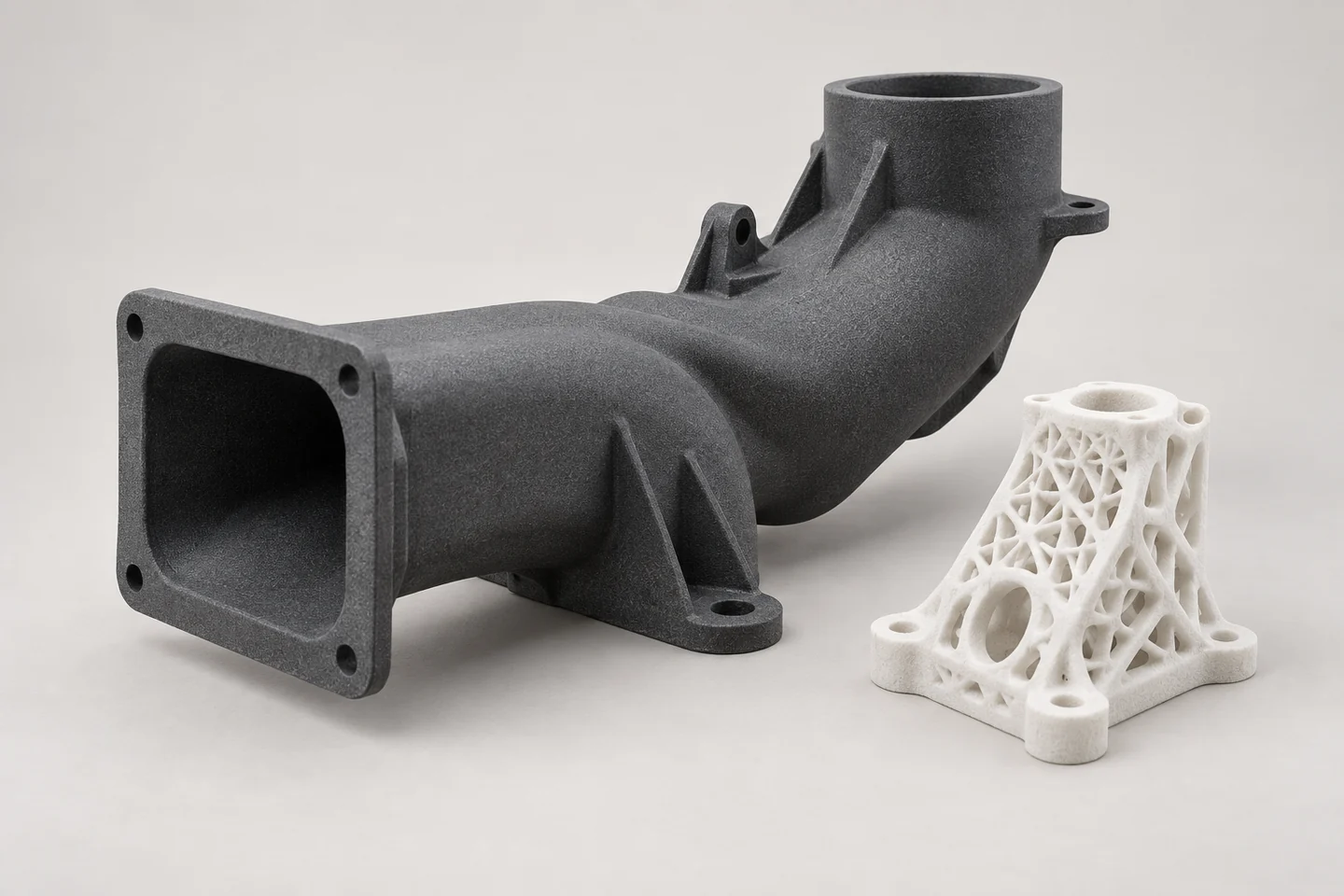
Existing generated polymer powder-printing concept. It does not verify an SLS machine, powder formulation, material properties or actual customer production.
01 / PROCESS FIT
Powder support during building does not remove the need to consider internal access or final acceptance. Begin with the requirement the part must answer.
Identify internal spaces, repeated features and delicate details. Compare actual feasibility with final cleanup and acceptance rather than assuming complexity is unlimited.
Map mating clearances, hinges or assembled regions. Review whether the proposed route and final-state work can support the intended motion or assembly check.
Describe load, duty and exposure. Exact powder and processed condition need relevant evidence; a nylon label alone does not qualify a part for every use.
02 / POWDER ACCESS
Hollow geometry, lattices and connected internal spaces should be reviewed through sections and openings. The cleanup question is part of design approval.
Identify cavities, exits and the internal purpose. Discuss approved changes needed for removal without assuming every hollow feature can be cleared.
Mark functional interfaces, flat or slender regions and visible faces. Review arrangement for the actual material and geometry.
Define the movement and final clearances. A model containing separate bodies does not prove that the finished parts move freely.
Highlight clips, thin walls and fragile transitions. Obtain project-specific review rather than publishing one universal minimum feature value.
03 / MATERIAL & FINISH
The offered material and surface operations should describe the part that will be accepted, including any functional or appearance-sensitive regions.
| Requirement | Provide | Confirm |
|---|---|---|
| Material identity | Exact powder or use-based selection brief. | Offered formulation and permitted alternatives. |
| Fit | Important dimensions, mating reference and state. | Appropriate method and final checks. |
| Texture and color | Visible faces and physical reference. | Included surface work and comparison basis. |
| Environment | Load, temperature, liquids or exposure duration. | Evidence relevant to the processed material. |
04 / CLEANUP & REFINEMENT
A completed print and a finished accepted component can have different scopes. Confirm cleanup and any additional surface or feature work.
Generated polymer geometry concept; not an actual SLS cleanup, finishing or inspection record.
Ask which powder cleanup operations are included and what relevant internal condition can be demonstrated. Do not infer the full path from exterior photographs.
Map appearance areas and protected interfaces. Confirm available options for the exact polymer and geometry.
If holes, inserts or mating surfaces need additional work, identify access and acceptance. Feasibility is a project review item, not an automatic inclusion.
Record material, approved geometry, arrangement and final state. Changes should be reviewed against earlier sample evidence.
05 / SAMPLE EVIDENCE
The sample record should separate visual approval from the requirements that need measurement or application checks.
| Decision | Record | Remaining question |
|---|---|---|
| Assembly fit | Mating reference and checked interfaces. | Unmeasured features or later changed geometry. |
| Internal access | Defined cleanup or functional evidence. | Volumes not covered by the agreed method. |
| Appearance | Physical reference and viewing conditions. | Material properties or numerical texture. |
| Application | Exact material, state and evaluation method. | Uses and exposure not represented by the test. |
06 / QUOTATION BRIEF
The quotation should connect printing to cleanup, refinement and the actual acceptance record. Quantity alone does not define the delivered requirement.
Files, powder, use and quantities.
Orientation and internal access.
Fit, cleanup and surface decisions.
Material, revision and finishing scope.
Agreed checks, identity and packing.
Send units, revision, drawing where available, internal sections, moving features, material requirements and destination.
Ask for preparation, printing, cleanup, surface work, inspection and records to be identified where relevant. Capacity, minimum quantity and timing remain proposal-specific.
07 / QUESTIONS
Treat powder removal and the delivered polymer state as part of the design.
No. Geometry, orientation, cleanup access, material and acceptance still require review.
No universal guarantee is made. Provide internal sections and agree removal access and relevant verification.
Define final clearances and movement and evaluate the processed sample. Separate bodies in a model do not prove the delivered result.
No equivalence is assumed between formulations. Control exact identity, processing and applicable evidence.
Only the agreed operations should be assumed. Specify surface scope, protected areas, final-state checks and records.
PREPARE THE NEXT DECISION
Include controlled files, polymer requirements, cavities and passages, moving or mating interfaces, surface intent, quantities, application checks and destination.
sales@keepwinco.comAn enquiry starts a team review. Material, fit, quantity, schedule, operation responsibility and supporting records are confirmed in the proposal; this form does not create an order or an instant price.
Start with what you know. Review your details before sending; no account needed.
Start parts inquiry →Your project is saved securely only when submission succeeds.
General material context only; external references do not certify a finished KeepWin product.
Formlabs - SLS process context ↗Formlabs - SLS orientation review ↗Formlabs - powder-access design context ↗