
Edges and handling
Define burr and sharp-edge requirements for assembly or contact. Identify edges that must preserve a functional profile after refinement.
PARTNER-SUPPORTED MANUFACTURING / SHEET SURFACES
Edges, texture, color and protected interfaces can require different operations. Map the surface purpose and define where final dimensions apply before selecting an offered finish.
KeepWin coordinates partner-supported review. Exact material, responsible operations, process availability, dimensions, inspection, commercial quantities and timing are confirmed in the project proposal; no universal capability or certification is promised.
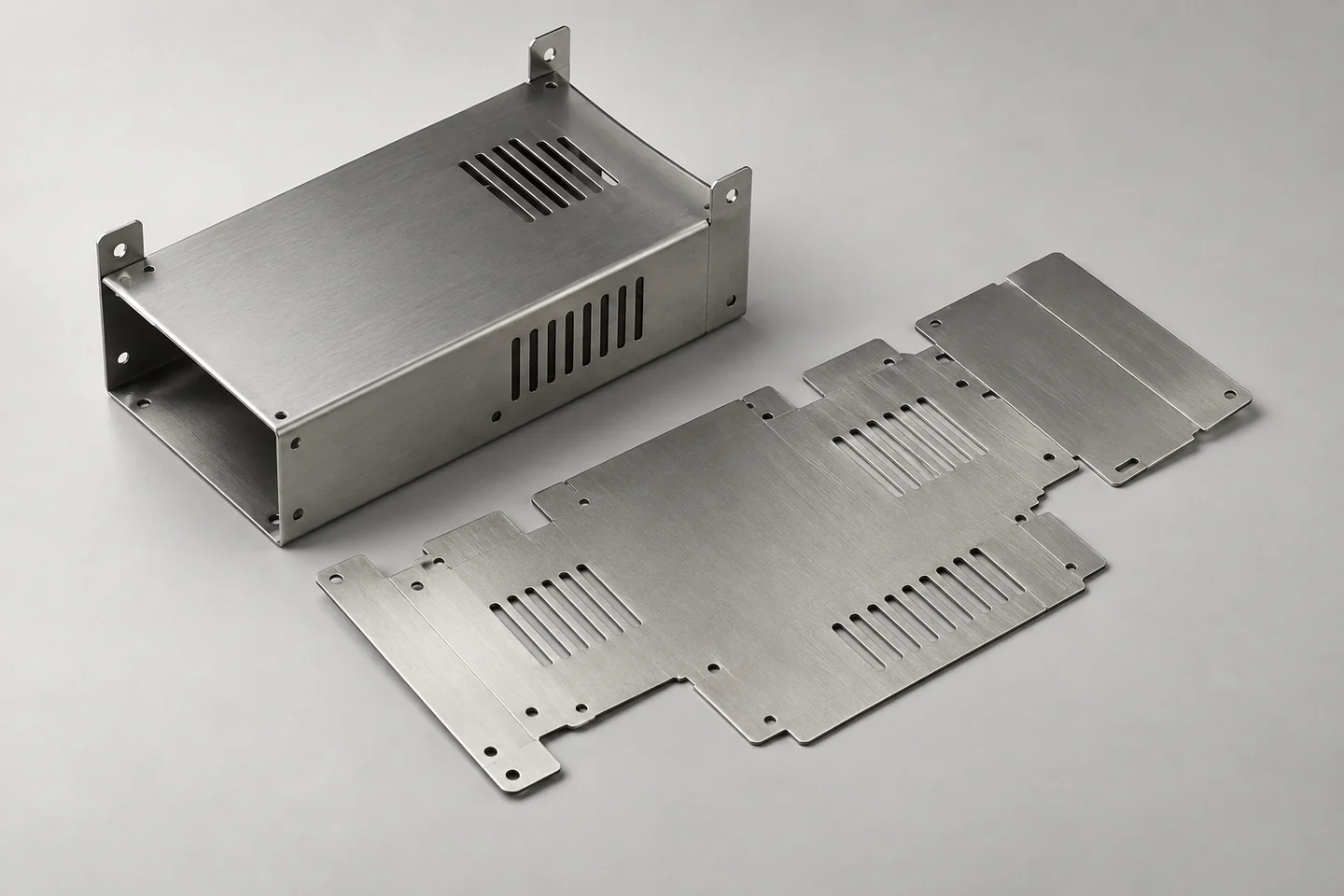
Generated sheet-part design reference, not an actual finished sample, measured result or verified equipment capability.
01 / FINISH PURPOSE
A broad finish name does not describe every face or requirement. Use the part function to decide which evidence matters.
Define burr and sharp-edge requirements for assembly or contact. Identify edges that must preserve a functional profile after refinement.
Map texture, color, direction and permitted fabrication traces. Agree a physical reference under defined viewing conditions.
Mark mating fits, contacts, sealing-related areas or sliding surfaces. Review protected zones and final-state checks for the actual application.
02 / TREATMENT MAP
Material removal or surface layers can change a fit or edge. The reviewed operation chain must preserve the delivered requirement.
Name grade, thickness and supplied surface state. Confirm the offered treatment compatibility instead of inferring it from another metal example.
Map holes, threads, mating and contact faces. Protection or masking availability requires actual review for the geometry and process.
State which forming, joining and surface operations occur before acceptance. A pre-coating measurement may not establish the delivered fit.
Define boundaries and transitions where different requirements meet. Review appearance and functional effects on the actual fabricated shape.
03 / OPTION COMPARISON
The examples guide a finish discussion; they are not a guaranteed availability list or a set of universal thickness values.
| Route | Review | Do not assume |
|---|---|---|
| Deburring and edge work | Edge geometry, access and required final condition. | No change to a small functional feature. |
| Brushing or polishing | Direction, material removal and visible areas. | Uniform results from an unspecified reference. |
| Blasting or conversion treatment | Exact stock, texture and protected faces. | Compatibility with every grade. |
| Coating or plating | Preparation, layer scope and final fits. | Fixed layer thickness or universal durability. |
04 / APPEARANCE REFERENCE
Stock, geometry, light and operation sequence can change how a surface looks. A digital image is direction rather than complete acceptance.

Supplied metal-stock reference, not a verified substrate-treatment pairing or finish performance result.
Record the substrate, treatment and sample geometry represented by the reference. Do not extend approval to another material automatically.
Define important faces, distance or lighting conditions as needed and permitted variation. Confirm the actual physical comparison method.
Identify seams, bends and areas where preparation may remain visible. Decide which marks are allowed rather than promising a trace-free surface.
A new coating, color, stock or preparation sequence can alter appearance and fit. Record who approves the change and what sample is needed.
05 / EVIDENCE
A colored or polished part does not by itself demonstrate wear, corrosion resistance, conductivity or contact suitability.
| Requirement | Agree | Record |
|---|---|---|
| Final fit | Post-treatment dimensions and mating checks. | State, method and sample selection. |
| Appearance | Physical reference and viewing conditions. | Exact substrate and finished configuration. |
| Surface parameter | Required measured criterion and location. | Appropriate method and report scope. |
| Application property | Defined use and relevant evaluation if needed. | Evidence, condition and responsibility. |
06 / QUOTE SCOPE
Surface work may include preparation, protection, samples and reports. Compare the same delivered state alongside quantity.
Send files, grade/thickness, edge and finish map, final fits, physical-reference intent, quantities, destination and mandatory evidence.
Ask for preparation, edge work, masking, treatment, samples, final checks, records and packing to be identified where relevant.
Agree responsible operations and exclusions, change approval and schedule basis. Process availability, MOQ and timing remain proposal-specific.
07 / QUESTIONS
A surface name needs a substrate, scope and acceptance basis.
Not necessarily. State a measured parameter and method if needed, or agree a visual reference and viewing basis.
It can affect final interfaces. Map protected areas and define dimensions and checks after relevant operations.
No. Required protection, feasibility and commercial scope must be confirmed for the actual process.
No. Appearance and application evidence are different. Define required evaluation and records separately.
Do not assume compatibility. Exact grade, supplied surface, geometry and responsible process require review.
PREPARE THE NEXT DECISION
Include stock grade and thickness, formed or assembled geometry, edge requirements, finish reference, protected contacts, final dimensions, quantities and destination.
sales@keepwinco.comAn enquiry starts a team review. Material, fit, quantity, schedule, operation responsibility and supporting records are confirmed in the proposal; this form does not create an order or an instant price.
Start with what you know. Review your details before sending; no account needed.
Start parts inquiry →Your project is saved securely only when submission succeeds.
General material context only; external references do not certify a finished KeepWin product.
Protolabs - sheet finishing context ↗