
Filament-based polymers
Identify exact filament and proposed build route. Review orientation, support-related areas and the surface state needed for the sample question.
MATERIAL REVIEW / ADDITIVE ROUTES
A polymer name or metal family does not describe every printed result. Connect exact material, build route, orientation and post-processing to the question the sample or delivered part must answer.
KeepWin coordinates partner-supported review. Exact material, responsible operations, process availability, dimensions, inspection, commercial quantities and timing are confirmed in the project proposal; no universal capability or certification is promised.
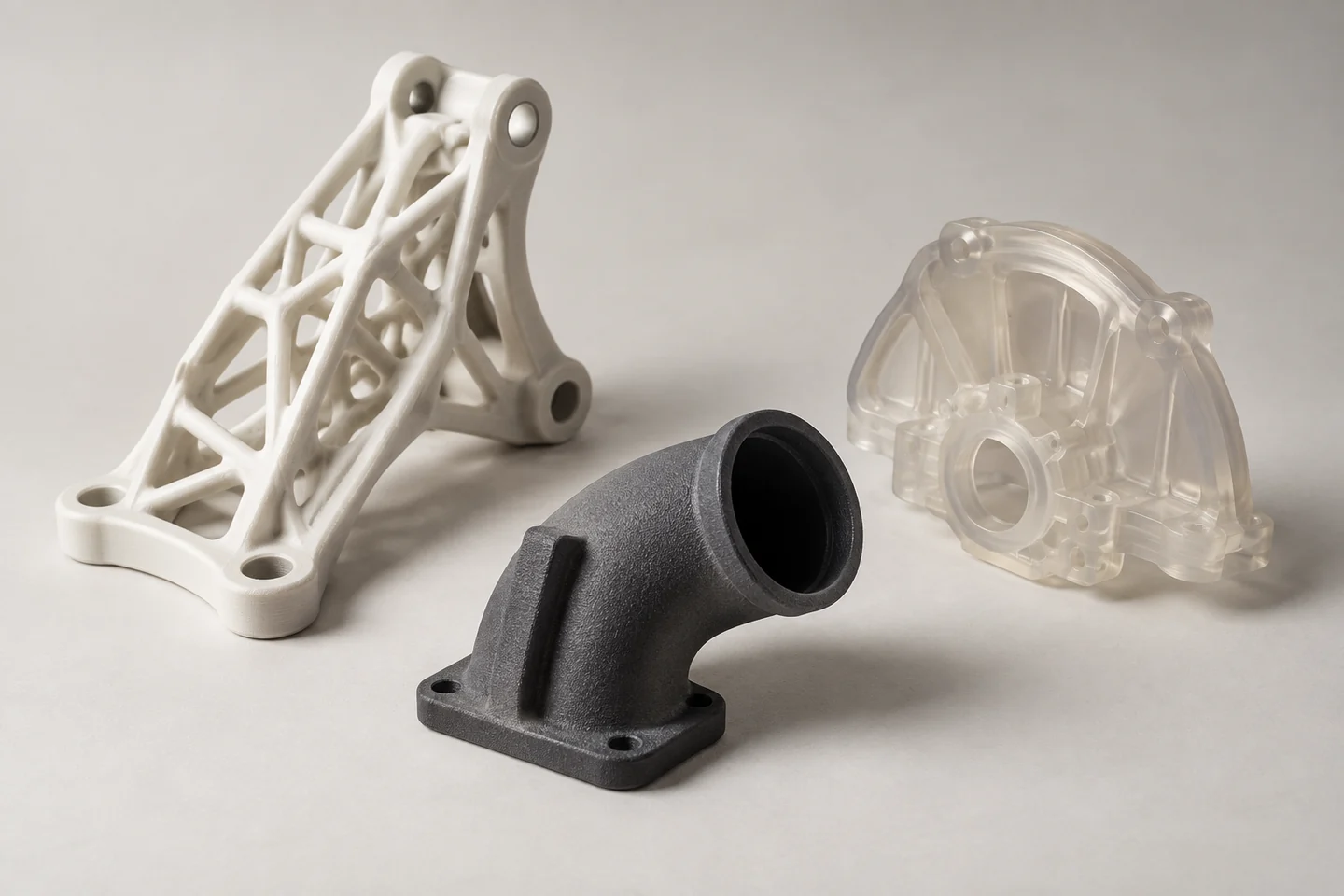
Generated printed-part concept. It does not identify a certified feedstock, measured property or universal process capability.
01 / ROUTE FAMILIES
These families organize the discussion rather than guarantee an available grade list. Exact supplies and routes require project confirmation.
Identify exact filament and proposed build route. Review orientation, support-related areas and the surface state needed for the sample question.
Specify the actual resin and processing configuration. Include support removal, cleaning and any required post-cure scope in the delivered definition.
Name exact powder and process route. Review build orientation, powder removal, secondary work and final evidence where relevant.
02 / MATERIAL SELECTION
A fit model, visual reference and functional evaluation may require different material and final-state choices. Keep the unrepresented properties visible.
State the assembly, appearance or use question and the acceptance condition. A shape match alone does not prove material suitability.
Supply required grade/formulation and relevant records. Confirm offered alternatives explicitly instead of treating a family label as equivalent.
Mark load/contact intent, slender features and critical interfaces. Review orientation-dependent questions for the actual route.
State support removal, cure/treatment, finishing and measurement state. Compare the delivered configuration rather than raw build appearance.
03 / COMPARISON QUESTIONS
Requested properties require relevant data or checks for the actual printed state. No numerical property table is invented here.
| Combination | Review | Evidence question |
|---|---|---|
| FDM-type polymer | Feedstock, direction and support interfaces. | What configuration does the evidence represent? |
| Photopolymer | Resin, cure and handling requirements. | Does it cover the intended final state? |
| Powder polymer | Process, surface and powder removal. | Which material and sampling scope apply? |
| Printed metal | Powder, build and secondary treatment. | What final-state records/checks are included? |
04 / POST-PROCESSING SCOPE
Cleaning, curing, machining or coating can change what the final part represents. Their inclusion and responsible operations should be visible in the proposal.
Identify where final dimensions apply and whether later machining or finishing is needed. Agree critical features and measurement method.
Map visible, mating and protected areas. Confirm included refinement and permitted support or process traces.
Ask what supply identity or applicable technical information is available. Feedstock information is not automatically a finished-part performance result.
Review substituted feedstock, orientation, process or secondary work against the earlier sample. Name the approval owner.
05 / ACCEPTANCE EVIDENCE
A material datasheet helps review a named product; a manufactured part may need evidence for its actual geometry and final state.
| Evidence | Identify | Limit |
|---|---|---|
| Supply identity | Exact grade/product and applicable lot scope. | Named supply, not all printed properties. |
| Dimensional check | Part/revision, features, method and state. | Agreed samples and characteristics. |
| Surface approval | Areas, reference and permitted traces. | Defined viewing and finish condition. |
| Use evaluation | Configuration, condition and criterion. | Only the represented application question. |
06 / ENQUIRY PREPARATION
Avoid comparing a raw build with a finished functional sample. Provide material, route and secondary-work assumptions beside quantity.
Send controlled files, sample/use purpose, exact material or permitted alternatives, critical features, surface scope and relevant conditions.
Identify preparation, printing, supports/powder removal, cure or treatment, secondary machining/finish, inspection, records and packing where relevant.
Agree the represented questions, limitations and change responsibility. Actual grade availability, build limits, minimum quantities and timing require proposal confirmation.
07 / QUESTIONS
The feedstock, build route and final condition belong together.
No. Confirm exact feedstock, process and relevant final-state requirements.
Only within its agreed evidence scope. State the use, configuration and required evaluation separately.
No universal part-property claim is made. Review applicability to the actual route and final state.
Only the agreed operations. Define support/powder removal, curing, treatment and finish requirements.
Review the changed configuration against prior approval and evidence before extending the sample decision.
PREPARE THE NEXT DECISION
Include CAD/drawing, process preference or alternatives, exact material where required, use conditions, orientation concerns, surface/final dimensions, evidence scope, quantities and destination.
sales@keepwinco.comAn enquiry starts a team review. Material, fit, quantity, schedule, operation responsibility and supporting records are confirmed in the proposal; this form does not create an order or an instant price.
Start with what you know. Review your details before sending; no account needed.
Start parts inquiry →Your project is saved securely only when submission succeeds.