
November 14, 2026
Grade 2 vs Grade 5 Titanium: How to Choose for Custom Parts
Choose Grade 2 titanium when the design benefits from commercially pure titanium, good formability and moderate strength. Consider Grade 5, also called Ti-6Al-4V, when higher strength is important to the part’s function. Neither choice should be made from the grade number alone. The right specification also depends on geometry, loading, manufacturing route, surface requirements and the evidence needed to approve the finished part.
A titanium watch band provides a useful starting point. Its visible links, small holes, moving joints and finished edges create several different requirements within one assembly. The same selection questions arise in a custom housing, mounting bracket, connector or decorative component. A stronger material may address one requirement while leaving fit, surface wear or stiffness largely unresolved.
This guide explains how to compare Grade 2 and Grade 5 for a real manufacturing project, how to request comparable quotations, and what to check before approving production.

Grade 2 vs Grade 5 titanium: a practical comparison
| Selection question | Grade 2 | Grade 5 | Project decision |
|---|---|---|---|
| What material is it? | Commercially pure titanium | Ti-6Al-4V titanium alloy | Write the exact grade into the specification. |
| What usually motivates selection? | Formability and a balance of moderate strength and corrosion resistance | Higher strength in a titanium component | Identify the actual service requirement. |
| Will it greatly change weight at the same dimensions? | Similar density to Grade 5 | Similar density to Grade 2 | Compare complete parts, not grade names. |
| Does the grade guarantee the finish? | No | No | Approve the required process and finished sample. |
| Does the grade define the manufacturing route? | No | No | Review geometry, stock form and operations. |
| What should a quote include? | Grade, condition, quantity, finish and acceptance requirements | The same information | Keep the quotation basis consistent. |
This comparison describes material selection, not a ranking of finished-product quality. Producer references from Carpenter Technology and TIMET provide the underlying grade identities and material characteristics. Final purchasing requirements must match the applicable product form and delivery condition.
What do Grade 2 and Grade 5 actually mean?
Grade 2 belongs to the commercially pure titanium family. Commercially pure does not mean chemically perfect titanium: the material specification controls permitted elements and impurities. For purchasing purposes, “pure titanium” is therefore less precise than a stated grade, product specification and condition. TIMET identifies its TIMETAL 50A as ASTM Grade 2 and supplies composition limits and property information.
Grade 5 is Ti-6Al-4V, an alloy named for nominal additions of about six percent aluminum and four percent vanadium. It is not a purer or newer version of Grade 2. It is a different material specification. TIMET’s Grade 5 datasheet also distinguishes ordinary Ti-6Al-4V from related variants, including the extra-low-interstitial material associated with Grade 23. These designations should not be treated as interchangeable.
In an inquiry, avoid phrases such as “Grade 2 or something better.” They leave the supplier to interpret what better means. If both grades are acceptable candidates, request two clearly identified alternatives and explain what the part must do. If only one grade is permitted, state that substitutions require written approval before material is purchased or parts are made.
Material identity also belongs at component level. A titanium assembly can contain springs, pins, screws, connectors or inserts made from other materials. Specifying the grade of a band body or housing does not establish the material of every item attached to it. A simple component list prevents a broad marketing description from becoming an ambiguous manufacturing instruction.
Compare strength, stiffness and weight separately
Grade 5’s higher strength can be useful when a component must resist permanent deformation under a defined load. However, strength and stiffness answer different questions. Strength concerns resistance to yielding or failure; stiffness concerns elastic deflection. TIMET’s titanium alloy comparison shows substantially different strength values alongside similar elastic-modulus ranges for these materials. Switching grades is therefore not a substitute for checking deflection.
For a thin cover that moves too much when pressed, start by examining the unsupported span, wall shape and attachment points. For a small lug that permanently bends, evaluate the load path, local section and stress concentration. Those are different design problems. A material change might contribute to the second solution without delivering the stiffness improvement expected in the first.
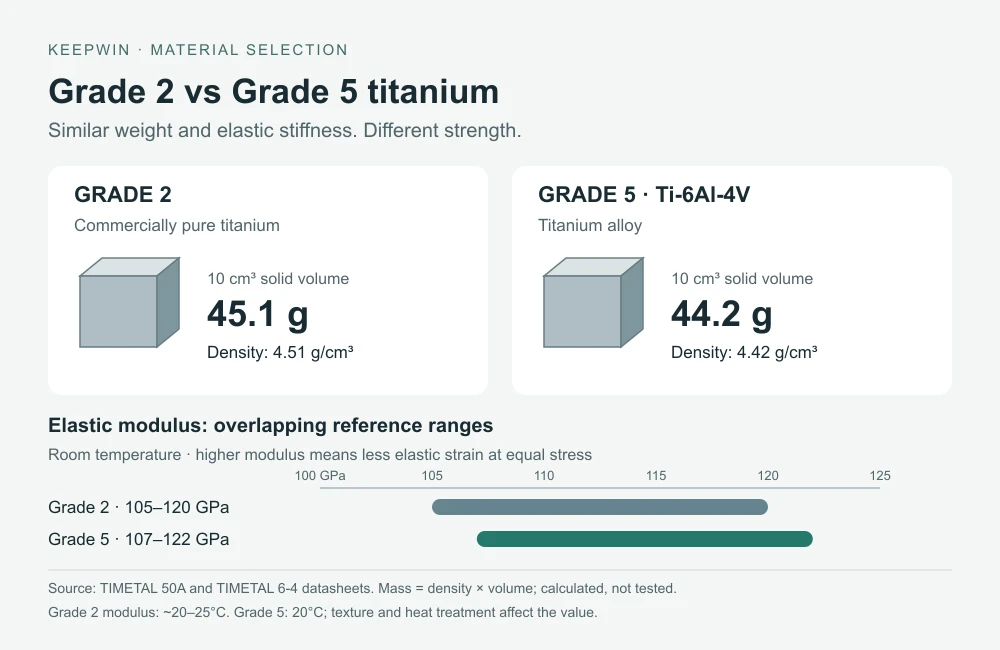
Density also deserves a separate comparison. TIMET lists approximately 4.51 g/cm³ for Grade 2 and 4.42 g/cm³ for Grade 5. Using those values, an illustrative solid volume of 10 cm³ would weigh about 45.1 g or 44.2 g respectively, before adding any other components. That calculated difference is about 0.9 g, not a dramatic reduction in complete-product weight.
A larger saving may be possible if a design can use less material, but that requires a new engineering assessment. Reducing thickness can affect stiffness, local bearing around holes, thread engagement, manufacturability and assembly feel. The fact that the starting alloy is stronger does not establish that every feature can become thinner by the same proportion.
When comparing samples, keep the geometry, usable length, hardware and finish consistent. Otherwise, a weight difference might come from a shorter part, a different clasp or fewer links. Record both the measured assembly weight and the configuration being weighed. A useful comparison makes the reason for the difference visible.
Titanium properties: compare the numbers and their conditions
The following producer data make the comparison more concrete. They are reference values, not specifications for a KeepWin delivery. In particular, typical strength figures do not establish an allowable load for a finished part.
| Property | Grade 2 | Grade 5 | Basis and limitation |
|---|---|---|---|
| Density | 4.51 g/cm³ | 4.42 g/cm³ | TIMET grade datasheets; Grade 5 value at 22°C. |
| Elastic modulus | 105–120 GPa | 107–122 GPa | Grade 2: typical at approximately 20–25°C. Grade 5: 20°C; texture and heat treatment affect the value. |
| 0.2% yield strength | 345 MPa | 885 MPa | Typical values in TIMET’s alloy chart: TIMETAL 50A and TIMETAL 6-4 rod, respectively. |
| Ultimate tensile strength | 485 MPa | 985 MPa | The same typical-value rows; these are not guaranteed delivery limits. |
Sources: TIMETAL 50A datasheet, TIMETAL 6-4 datasheet and TIMET’s typical alloy-property chart. The chart does not identify a matching product form and condition for both selected strength rows. Use it to understand the broad difference, not to calculate an exact grade-to-grade performance ratio.
For design or acceptance, obtain values that match the stock form, dimensions, condition and applicable specification of the actual order. Keep minimum values separate from typical results. Yield strength concerns the onset of permanent deformation; tensile strength describes a different point in the tensile test. Neither replaces a calculation for the component’s geometry and load.
Record the source and test conditions beside every number. A result at an elevated temperature, or from a differently treated product, should not silently replace room-temperature data. Missing information is a question for the material supplier, not a reason to borrow a convenient number.
Finally, separate material compliance from part inspection. A valid material record does not prove hole position, articulation or appearance. Those still need checks on the finished component.
Define the environment and contact conditions
Grade 2 is widely used where corrosion resistance and fabrication characteristics matter, as described in Carpenter’s material overview. That does not make either grade universally suitable for every chemical, temperature or assembly. An outdoor accessory and a component exposed to a process fluid need very different application information.
Describe actual exposure: occasional splashing, prolonged immersion, cleaning chemicals, operating temperature and whether liquid can remain trapped between components. Identify adjoining materials and any electrical or mechanical contact. When the environment is demanding, request application-specific review rather than relying on a general statement that titanium resists corrosion.
Separate corrosion from cosmetic wear. A part may retain its structural function while developing visible marks. Conversely, a polished surface can look acceptable without proving that a hidden interface meets its requirements. Define the important outcome: retained appearance, reliable movement, dimensional stability or resistance to a specified environment.
Skin-contact products also require an assembly-level approach. Confirm the materials and finishes of the surfaces that actually touch the wearer, including hardware. Avoid treating the main body’s material name as evidence for every component or as a universal promise about individual sensitivity. Any required market-specific testing should be agreed for the finished configuration.
How do Grade 2 and Grade 5 affect CNC machining?
Both materials can be machined, but a quote should reflect the actual alloy and condition. Sandvik Coromant’s titanium milling guidance describes demanding thermal, chemical and mechanical loads at the cutting edge. Its application guidance also discusses coolant delivery, tool engagement and component deflection. These are reasons to plan the operation around the material and geometry.
Titanium’s cutting behavior also explains why “softer” does not mean effortless machining. ISCAR’s titanium machining guide connects poor heat transfer, adhesion at the cutting edge and elastic deflection with machining difficulties. For a thin component, the plan must address both cutting-edge conditions and how the part is supported.
On the drawing, a long unsupported wall, an inaccessible inside corner or a hole close to an edge can matter as much as the grade choice. Discuss whether a larger internal radius, a shorter tool reach or stock left for a final finishing operation would preserve the function while improving control. These are proposals to review with the manufacturer, not a claim about the route used for a pictured product.
For the customer, the most useful contribution is often a clear design review. Mark the faces that locate the part, the holes that control assembly, and the surfaces that need a particular appearance. Explain whether a pocket is necessary for clearance, weight reduction or styling. The machinist can then distinguish essential features from features that could change without affecting function.
Consider a small link with a deep narrow recess and two accurately positioned holes. The grade is only one input. Tool access, the available clamping surface and the relationship between the holes may determine how many setups are needed. An attractive redesign that removes the only practical holding area can make the part harder to manufacture even when the material remains unchanged.
Ask for proposed changes in a form that can be approved: a marked drawing, an updated model or a short list of affected dimensions. “Make it easier to machine” is too open-ended. A useful proposal identifies the feature, the proposed revision and the functional consequence that the design owner must evaluate.
Do not transfer a cutting-speed recommendation from an online example into a purchase requirement. Tool diameter, engagement, machine rigidity, coolant delivery and workpiece condition change the appropriate settings. The project specification should define the required finished result; the manufacturing plan should establish a suitable route to achieve it.
KeepWin’s CNC machining service information explains the project inputs needed for review. A titanium part inquiry should identify the requested grade from the outset so material sourcing, processing and inspection can be evaluated together.
Check forming, joining and moving interfaces
If the component will be bent or formed, discuss that route before approving the grade and drawing. Grade 2’s formability is one reason to consider it, but a material name alone does not establish an acceptable bend radius, tooling arrangement or finished tolerance. Thickness, condition and the intended sequence need review.
For welded or bonded assemblies, specify which components are being joined and what the joint must withstand. Do not assume that a successful sample made in one material automatically qualifies a revised material or surface treatment. The joint design, preparation and acceptance method should remain connected to the approved configuration.
Moving interfaces need their own requirements. Identify the mating pin, hole, bearing surface or sliding contact, then describe the intended clearance, load and movement. A higher-strength body does not independently define a durable joint. For watch-band projects, the existing connector-fit checklist provides a separate framework for reviewing the watch attachment interface before sampling.
Choose the finish independently of the grade label
“Natural titanium,” “black titanium” and “polished titanium” do not specify a material grade. They describe an appearance or commercial presentation. A product photograph cannot establish the alloy, the coating process or the finishing sequence. Keep material selection and finish selection as separate fields in the project brief.
Color anodizing provides one example of why process terminology matters. Titanium Finishing Company describes color formation through control of the titanium oxide layer and notes that screen colors are references rather than physical approval standards. That process description does not identify the treatment used on any particular KeepWin product.
For a comparison sample, specify the intended appearance on the actual geometry. Define visible faces, grain direction, gloss, edge transitions and areas that should remain protected. A flat finish coupon can help start the discussion, but it may not show how a treatment appears on a curved link, recessed pocket or narrow edge.
Decide whether dimensions are to be accepted before or after the final treatment. Where two parts must fit together, the finished assembly is usually the relevant object to review. If the material or finish changes after approval, identify which checks must be repeated rather than assuming the previous sample remains representative.
Avoid a blanket “scratch-proof” claim for either grade. If cosmetic durability matters, describe the expected contact and agree on a relevant evaluation. Photograph the approved sample under repeatable lighting and retain a physical reference. KeepWin’s surface-finish reference guide explains how to document appearance requirements without relying on subjective adjectives.
Grade 2 vs Grade 5 titanium cost: compare the finished part
Request both grades against one drawing revision, quantity and finish. A universal Grade 5 price multiplier would be misleading: stock availability, the amount removed, tool life, setup and inspection can change the result.
A thin link cut from an oversized blank may generate substantial scrap and require several setups. A simpler bracket may use stock more efficiently even if it weighs more. For a small batch, the minimum stock purchase and fixture cost can matter more than the finished part’s material weight. Ask which items actually change between the two proposals.
Separate material, machining, finishing and one-time setup charges where practical. Keep sample scope and inspection records consistent. If a supplier changes wall thickness to make Grade 5 more attractive, evaluate that as a revised design with new stiffness, fit and manufacturing checks. It is no longer a comparison of two grades in the same part.
Price becomes useful when it is tied to a requirement. Pay for a material advantage the design can use, and confirm it through the appropriate engineering and sample review.
Three selection examples beyond a material comparison table
The following are illustrative planning scenarios, not completed KeepWin projects or test results. They show how the same grade comparison can lead to different questions.
A titanium watch-band collection
A brand wants two versions of one band design at different price points. The initial task is to keep the comparison controlled: same band length, connector, closure, finish and packaging. Request the body in Grade 2 and Grade 5, and identify the material of supporting components separately. Compare complete samples for articulation, edge comfort, clasp operation and fit.
The decision should connect to a defined product requirement. If the brand cannot explain what the higher-strength version is intended to improve, it should avoid promising superior durability solely from the grade number. It can accurately identify the selected material while evaluating any performance claim through an appropriate test.
A compact machined mounting bracket
A designer needs a small bracket within a fixed envelope. Start with the applied loads, mounting arrangement and permissible displacement. If the concern is permanent deformation, assess material strength and local geometry. If the concern is movement under normal load, assess stiffness and the supporting structure. Keep those acceptance criteria separate in the design review.
Request quotations only after the critical features are identifiable. A supplier should not have to infer the load-bearing surfaces from an attractive rendering. If the drawing changes to use a different material, document the new revision and verify that adjacent components still fit.
A formed cover with a visible surface
A product team wants a thin titanium cover with folded edges and a consistent appearance. The early review should focus on forming requirements, dimensional control and the finishing sequence. Grade 2 may be a candidate worth evaluating, but that is a starting point for a process review, not approval of a particular bend.
Ask for a representative sample that includes the difficult corner and visible surface. Approving a flat piece alone would leave the main manufacturing question unresolved. Compare the sample with the mating assembly and confirm which surfaces determine acceptance.
Specify the grade at component level
Put the material decision on the drawing or accompanying specification, linked to its revision. For an assembly, identify which components the grade covers. A Grade 5 link body does not imply a Grade 5 spring, pin or clasp.
| Specification field | What to record |
|---|---|
| Material | Grade 2 commercially pure titanium or Grade 5 Ti-6Al-4V; identify the affected components. |
| Supply basis | Stock form, condition, applicable specification and permitted substitutions. |
| Critical features | Datums, mating dimensions, tolerances and edge requirements. |
| Finish | Treatment, visible faces, masking and acceptance after finishing. |
| Evidence | Required material records, batch traceability and part inspection results. |
A generic datasheet explains a material family; it is not the certificate for your delivery. Check that the supplied records correspond to the ordered grade and batch, and agree how that identity remains connected to the finished parts. If additional identification testing is required, define the method and its limitations before ordering.
Use KeepWin’s CAD and drawing preparation guide to organize the geometry and documentation. Keep the grade, finish and hardware scope in separate fields so a change to one does not silently change the others.
What should you check on Grade 2 and Grade 5 samples?
Compare the same geometry, finish and assembly configuration. Label any differences before testing; otherwise, an observation about a thicker wall or a different clasp could be incorrectly attributed to the grade.
- Material identity: match the sample to the drawing revision, declared grade and agreed batch records.
- Critical dimensions: measure locating faces, holes and mating features against the specified datums and tolerances.
- Interfaces: check clearances, articulation and fastening with the intended mating components.
- Appearance: compare visible faces, grain direction and edges under consistent lighting.
- Function: use defined loads and acceptance criteria for the actual application; visual approval alone does not establish load capacity.
- Decision: record what is approved, what needs correction and which changes require another sample.
Small, flexible parts need a repeatable measurement setup. Record whether the component is supported, clamped or free when measured. A reading under clamping force may conceal springback after release. Choose an instrument and support arrangement appropriate to the feature and tolerance, rather than relying on a photograph or an informal impression of fit.
For the watch-band example, check articulation and edge feel at the intended wrist size, as well as connector and clasp operation. For a bracket, the relevant evidence may instead concern displacement under load and permanent set after unloading. The sample review should answer the design question that led to choosing the grade.
Retain the approved sample and records. A later change of grade, geometry or finish should trigger review of the affected checks, even when the external appearance seems unchanged.
Frequently asked questions
Is Grade 5 titanium always better than Grade 2?
No. Grade 5 offers higher strength, but the project may prioritize forming, appearance, cost or a different functional requirement. Choose against the part’s acceptance criteria. A higher grade number does not mean that every property improves or that the completed assembly has been validated.
Can you identify the grade from a photograph?
No. Color, polish and machining marks are not reliable proof of grade. Establish the material through the specification, traceable supply records and any agreed verification. A photograph is useful for discussing geometry and appearance, but it cannot replace material identification.
Will a Grade 5 version weigh much less?
Not simply because the grade changes. At equal volume, the density difference between these two materials is small. Compare the actual geometry and complete assembly. Any larger weight reduction achieved through redesign needs its own functional and manufacturing review.
Does a titanium band contain only titanium components?
Not necessarily. Pins, springs, screws, clasps or connectors may use other materials. Request a component-by-component description where that matters. Confirm which parts the selected Grade 2 or Grade 5 option covers before using the grade in a product specification or sales claim.
Can I switch grades after approving a sample?
Treat the switch as a controlled change. Update the material specification and quotation, then determine which dimensional, functional, appearance and process checks must be repeated. An approved sample in one grade is not automatically an approval of a second material configuration.
Should I request the same finish on both comparison samples?
Usually that makes the comparison easier to interpret, provided the proposed finish is suitable for both configurations. If different processes are proposed, identify them and evaluate the finished samples separately. Avoid attributing a difference in color, gloss or texture solely to the titanium grade.
Discuss a Grade 2 or Grade 5 project with KeepWin
KeepWin offers Grade 2 and Grade 5 material options across its titanium watch-band designs. State your preferred grade explicitly when requesting a quotation. The titanium component scope, supporting hardware, finish, dimensions, sample requirements and commercial terms should be confirmed for the selected build.
Use the titanium watch-band collection to choose a design direction. For example, the KW-4037 fine-link design and KW-4041 link design provide different starting points for a material and sample discussion. Their photographs are design references, not proof of the grade in a requested configuration. A Grade 5 version should be described as Ti-6Al-4V titanium alloy rather than commercially pure titanium.
For a watch-band project, send the design reference, target watch interface, preferred grade and estimated quantity through the watch-band inquiry page. For a housing, bracket, connector or another custom component, use the parts manufacturing inquiry page and include the drawing or CAD model, intended use, critical dimensions and surface requirements.
If the grade is still undecided, request clearly separated Grade 2 and Grade 5 proposals against the same project brief. That gives you a practical basis for comparing material, manufacturing scope and finished samples before committing to production.
Technical sources and how to use them
The producer and process references below support the material discussion. They do not certify a KeepWin product or establish its manufacturing history. Match any acceptance requirement to the applicable current specification and your ordered configuration.
- TIMETAL 50A and TIMETAL 6-4: grade identity and physical-property data.
- TIMET titanium alloy chart: typical mechanical properties, with separate Grade 5 product forms.
- Sandvik Coromant titanium milling guidance and ISCAR titanium machining guide: cutting and process-planning considerations.
- Titanium Finishing Company color anodizing reference: oxide color and appearance approval.