
September 28, 2026
Watch Band Connectors and Clasps: A Design and Sourcing Guide
Connectors and clasps are the small parts that decide whether a watch band fits, stays on the wrist, and feels well made. If you are developing a band collection, the practical answer is this: define how the band attaches to the watch or device before you finalize anything else, choose a clasp that matches the strap material and the wearer’s activity, and approve both on real cases or devices, not on drawings alone. Most fit complaints, returns, and “cheap feel” comments trace back to these parts rather than to the strap itself.
This guide is written for brand owners, product designers, and sourcing teams planning custom or private-label bands. It explains the main connector and clasp types, the dimensions that matter, how these parts are made, what drives cost, and what to check during sampling and inspection.
Key Takeaways
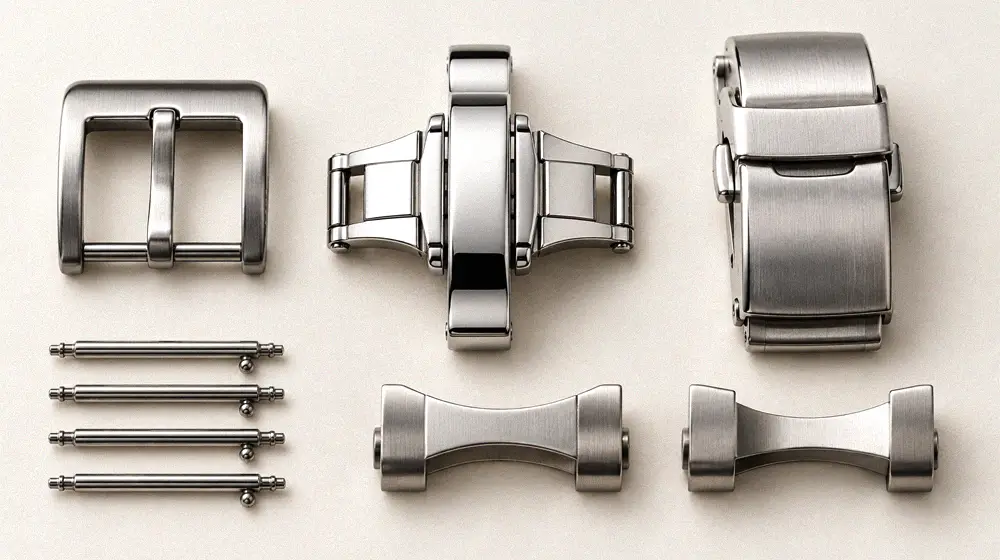
- The attachment system is a set of parts that must work together: lugs, spring bars or pins, end links or strap ends, and, for smartwatches, a device-specific connector.
- Lug width alone does not guarantee fit. Spring bar tip diameter, lug hole position, case curvature, and clearance all matter.
- Fitted end links and smartwatch connectors are model-specific. Plan for measurements, reference samples, and physical fit checks on each supported model.
- Clasp choice should follow the strap material and use case. A pin buckle suits leather and rubber; a folding clasp suits metal bracelets; dive and sport bands benefit from secure locking and on-the-wrist adjustment.
- Manufacturing method changes cost and feel. Stamped, metal injection molded (MIM), and computer numerical control (CNC) machined parts differ in tooling, detail, and weight.
- Specify tests and acceptance criteria up front, including retention, opening and closing cycles, and fit, rather than relying on “good quality” as a requirement.
The Parts of a Watch Band Attachment System
Before comparing options, it helps to use the same vocabulary as your supplier.
- Lugs: The projections on the watch case that hold the band. The distance between them is the lug width, commonly an even number of millimeters such as 18, 20, or 22 mm.
- Lug holes: Small holes or recesses inside the lugs where spring bar tips sit. Some lugs have holes drilled all the way through, which makes band changes easier.
- Spring bars: Spring-loaded pins that pass through the strap or end link and snap into the lug holes. Most traditional watches use them.
- End links: The first metal pieces of a bracelet, shaped to meet the case. They can be straight or fitted to a specific case profile.
- Strap ends: On leather, rubber, and fabric straps, the end folds or molds around the spring bar, sometimes with a curved shape that follows the case.
- Smartwatch connectors: Device-specific adapters that slide or latch into slots on a smartwatch or fitness tracker. They replace lugs and spring bars.
- Clasp or buckle: The closure that fastens the band around the wrist.
- Keepers: Loops that hold the free end of a strap in place.
Each of these parts has its own tolerances, and small mismatches between them add up.
Spring Bars: Small Parts, Big Consequences
Spring bars look simple, but they are the most common single point of failure in a traditional strap.
Key dimensions
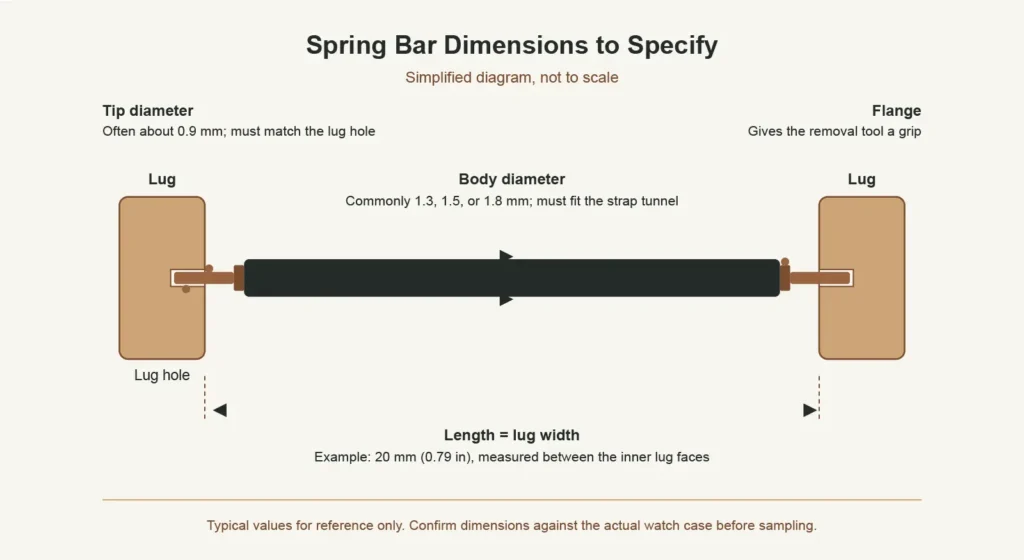
A spring bar has three dimensions you should specify:
- Length: Matches the lug width. A 20 mm lug width uses a 20 mm spring bar, measured with the bar compressed between the lugs.
- Body diameter: The thick middle section that passes through the strap or end link tube. Common body diameters include 1.3 mm, 1.5 mm, and 1.8 mm, and heavier-duty bars are thicker still (Oak & Oscar).
- Tip diameter: The small ends that sit in the lug holes. Tips are fairly standardized, often around 0.9 mm, but some watches use larger holes and thicker tips (Oak & Oscar). A tip that is too thin for the lug hole can rattle, wear the hole, or pop out.
The body diameter must also leave clearance between the strap and the case. A thick strap with a large spring bar tunnel can bind against the case back or the lug tips, making the band stiff at the attachment point.
Spring bar types
- Single- or double-flanged: Small flanges near the tips give a spring bar tool something to push against. This is the most common type.
- Shoulderless: Designed for lugs drilled all the way through. They are pushed out from the side with a pin tool.
- Fat or heavy-duty bars: Larger body and tip diameters for dive and sport watches or heavy bracelets.
- Curved: Bent bars that create extra clearance for thick straps or tight case designs.
- Quick-release: A small lever lets the wearer release the bar without tools. These are popular for wholesale and accessory ranges, but the lever adds a part that can catch on clothing, and the tips are often limited in size (aBlogtoWatch).
Material and quality
Spring bars should be made from stainless steel, and the internal spring matters as much as the tube. Low-quality bars can rust internally, lose spring force, or bend under load. For premium ranges, ask the supplier which grade is used for the tube and tips, and include spring bars in your inspection plan.
Pin and screw alternatives
Some watches do not use spring bars at all. Screw bars thread into the lugs, and fixed pins require specific strap designs. If your target watches use these, the band must be designed around them from the start.
End Links: Straight vs. Fitted
For metal bracelets, the end link determines how the bracelet meets the case.
Straight end links
Straight end links have a flat or simple profile. They fit many watches with the right lug width, which makes them attractive for wholesale and aftermarket ranges. The trade-off is appearance: straight ends usually leave a visible gap between the bracelet and a curved case.
Fitted (curved) end links
Fitted end links follow the curve of a specific case. They look integrated and are standard on premium bracelets. However, they only fit the case they were designed for, and small differences in case geometry can cause gaps or rubbing.
To design a fitted end link, a supplier typically needs:
- A physical watch case or a detailed case drawing.
- Lug width, lug length, lug hole position, and lug hole diameter.
- The case profile between the lugs, including any curvature or bevels.
- The case thickness at the lugs and clearance to the case back.
Without real reference parts, fitted end links often need several rounds of adjustment.
Solid vs. folded end links
End links can be machined from solid metal, metal injection molded, or folded from sheet. Solid and MIM end links feel substantial and hold their shape. Folded end links are lighter and less expensive but can rattle or deform. Match the end link construction to the rest of the bracelet; a solid-link bracelet with folded end links feels inconsistent.
Rotation and clearance
The first link must rotate freely enough for the bracelet to wrap around the wrist. If the end link is too tight against the case, the bracelet will stand away from the wrist, especially on smaller wrists. Check articulation on samples, not only static fit.
Smartwatch Connectors
Smartwatch bands replace lugs and spring bars with device-specific connectors. These are a major product category for wholesalers and accessory brands, but they come with extra risk.
How smartwatch connectors differ
- Model-specific geometry: Each device family uses its own slot or latch design. Connector dimensions can differ between device sizes and, in some cases, between generations.
- Tight tolerances: A connector that is slightly too loose will rattle or slide; one that is too tight may be hard to insert or may scratch the device.
- Locking features: Many connectors rely on a spring-loaded latch or detent. The spring force and latch geometry determine how securely the band stays in place.
- Material mix: Connectors may be stainless steel, aluminum, or plastic, and the band body may be a different material. Joining methods, such as molding, screws, or pins, affect durability.
Compatibility claims
Do not describe bands as compatible with a device based only on a nominal size. Confirm fit on each device model and size you plan to list, and document which models were checked. Using a device brand’s name to describe compatibility is a legal question in each market; avoid logos, official-looking marks, or wording that implies endorsement or authorization unless you have it.
What to specify
- Exact device models and sizes to support.
- Connector material and finish, including whether it should match a particular device finish.
- Insertion and removal feel, and whether the connector must lock with an audible click.
- How the connector attaches to the band body.
- Acceptance criteria for play and rattle.
Clasp Types Compared
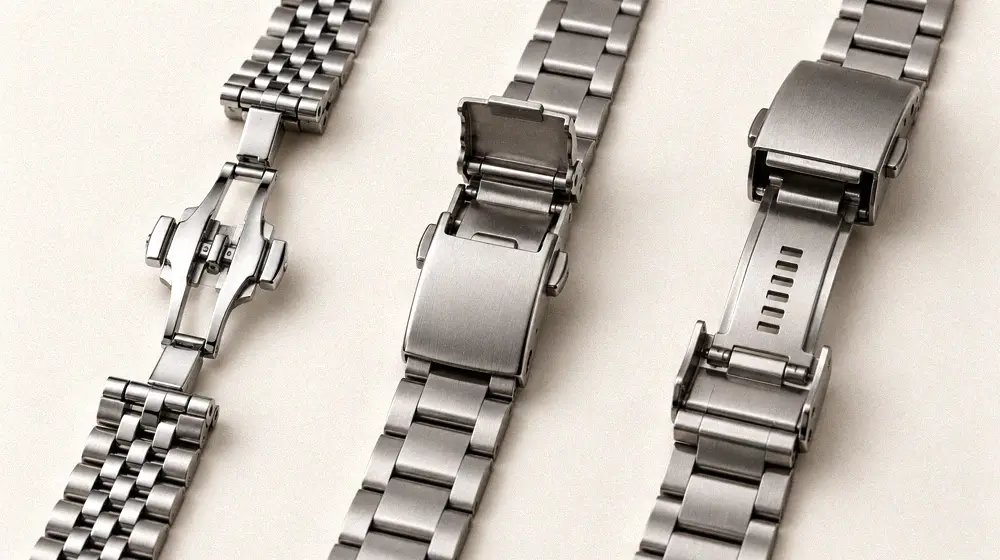
The right clasp depends on the strap material, the product’s price point, and how the wearer uses the watch.
| Clasp Type | Common Uses | Strengths | Trade-Offs |
|---|---|---|---|
| Pin buckle (tang buckle) | Leather, rubber, fabric straps | Simple, familiar, low cost, easy to brand | Wears strap holes; less secure if dropped while fastening |
| Deployant buckle for straps | Premium leather and rubber straps | Reduces strap wear, easier to put on | More parts and cost; strap must be cut or sized to fit |
| Butterfly deployant | Dress bracelets | Clean, nearly hidden look | Less secure on some designs; limited adjustment |
| Fold-over clasp with safety flip-lock | Metal bracelets, sport watches | Secure, widely understood | Bulkier than hidden clasps |
| Push-button fold-over clasp | Metal bracelets, mid to premium | Easy to open, neat appearance | Button springs need quality control |
| Dive clasp with extension | Dive and sport bracelets | Fits over wetsuits or allows wrist expansion | More complex, higher cost |
| On-the-wrist micro-adjustment | Sport and premium bracelets | Adjusts for heat or exercise without tools | Adds cost and design complexity |
| Magnetic closure | Mesh and some smartwatch bands | Quick and infinitely adjustable | Can release under force; magnet strength must be checked |
Choosing by strap material
- Leather: Pin buckles are standard. Deployant buckles extend strap life and suit premium lines.
- Rubber, FKM, and silicone: Pin buckles are common. Deployant buckles work but need compatible strap ends and thickness.
- Metal bracelets: Folding clasps are standard. Consider push-button clasps for ease of use, and a safety lock for sport or dive products.
- Mesh bracelets: Sliding or magnetic clasps allow fine adjustment but require secure retention.
- Fabric and NATO-style straps: Usually use pin buckles and keepers, with no spring bar tunnel in some designs.
Adjustment options
Fit is a frequent reason for returns. Adjustment features to consider:
- Micro-adjustment holes: Several spring bar positions in the clasp allow small changes in length.
- On-the-wrist extension: A sliding or ratcheting mechanism in the clasp that adjusts without tools.
- Removable links and half links: For metal bracelets, these allow sizing in finer steps.
- Multiple strap lengths: For straps, offering short, regular, and long sizes reduces fit complaints.
Materials and Manufacturing Methods
Clasps and connectors are usually metal, and the production method strongly influences detail, strength, and cost.
Common materials
- Stainless steel: 316L is widely used for clasps and end links; ask for the grade of each part. Some buckles in low-cost ranges use other grades or zinc alloys, so specify your requirements.
- Titanium: Used for lightweight and premium bands. Titanium clasps can be paired with steel springs and pins, so confirm the materials of all parts.
- Aluminum: Sometimes used for lightweight smartwatch connectors. It is softer and usually anodized for color and wear resistance.
- Engineering plastics: Used in some smartwatch connectors and entry-level parts.
For skin-contact compliance, remember that clasps and connectors are often the parts with the most skin contact. In the European Union, for example, nickel release from watch straps and similar articles is limited under REACH and tested using EN 1811. Include clasps and connectors in any compliance testing.
Production methods
- Stamping and forming: Sheet metal is cut and bent. It is cost-effective at volume and common for buckles and simple clasp blades, but limits detail and thickness.
- Metal injection molding (MIM): Metal powder mixed with binder is molded, then debound and sintered. MIM produces complex, solid shapes at volume, such as fitted end links and clasp bodies, with less machining. It requires tooling and careful control of shrinkage.
- CNC machining: Parts are cut from solid bar or plate. It suits premium parts, small batches, and prototypes, but costs more per part.
- Casting: Used for some buckles and decorative parts, particularly in lower-cost ranges.
Many clasps combine methods: a MIM or machined body, stamped blades, and small springs and pins. The quality of the springs and pins affects durability as much as the main parts.
Finishing
Clasps and end links usually need to match the bracelet or watch case finish. Brushed, polished, bead-blasted, and coated finishes behave differently on small, complex parts. Approve finish samples on actual clasp parts, not only on flat panels, and check edges and inner surfaces where the clasp contacts the wrist.
Design Considerations for Custom Clasps and Connectors
If you are developing a custom clasp or connector rather than choosing a standard part, keep these points in mind.
- Start from the watch or device. Define the attachment geometry first, then design the band around it.
- Decide early between standard and custom parts. Standard clasps and connectors reduce tooling and development time. Custom parts create differentiation but need more sampling.
- Allow for tolerances. Watch cases and devices vary slightly. Design connectors and end links with enough tolerance to fit across normal production variation, then confirm with samples from more than one unit.
- Keep clearances for straps. Thick straps need room around the spring bar and between the strap and case.
- Consider wear points. Hinge pins, latch edges, and spring contact points wear first. Hardened pins, good surface finish, and adequate material thickness help.
- Plan branding placement. Clasps are the most common place for logos. Decide on engraving, laser marking, or embossing, and check that marking does not weaken thin parts.
- Think about comfort. Clasp thickness, edge radius, and the underside surface affect comfort. Test on different wrist sizes.
Testing and Validation
“Strong” and “secure” mean little unless you define how they are tested. Agree on tests and acceptance criteria with your supplier before sampling.
Useful tests to consider
- Attachment pull test: Apply a tensile force to the attached band and check that it does not separate. For reference, ISO 6425, the international standard for divers’ watches, includes a strap attachment resistance test, commonly summarized as a 200 N force applied to the attachment without separation (ISO 6425 overview; ISO 6425 standard page). It is a useful benchmark for sport products, but it is not a requirement for every band.
- Clasp retention: Check that the clasp stays closed under a defined load and does not open accidentally during movement.
- Opening and closing cycles: Repeat opening and closing many times to check for loosening, spring fatigue, and finish wear. Agree on the number of cycles.
- Spring bar and connector retention: Check that spring bars and connectors stay seated and do not work loose with movement.
- Corrosion and sweat exposure: Check that clasp springs, pins, and coatings do not corrode or discolor.
- Finish wear: Check coated or polished clasp surfaces for wear at contact points after cycling.
Your supplier may perform some tests in-house and others through a third-party laboratory. Ask which tests are available, what equipment and methods are used, and what documentation you will receive. Do not assume a supplier can perform a specific test until it is confirmed.
Sourcing: Standard vs. Custom Parts
Standard parts
Using a supplier’s existing clasp and connector designs is usually the fastest and lowest-risk route. Standard parts are proven, tooling already exists, and minimum quantities may be lower. The trade-off is less differentiation.
Modified standard parts
Adding your logo, changing the finish, or adjusting a dimension on an existing design is a common middle ground. Engraving and finish changes are usually straightforward; dimensional changes may require tooling changes.
Fully custom parts
A custom clasp or connector gives you a distinctive product and exact fit, but it requires design work, tooling, and multiple sampling rounds. Budget for development time and tooling costs, and be clear about who owns the tooling and design files.
What drives connector and clasp costs
Clasps and connectors can account for a large share of a band’s cost, especially on strap products where the strap body is relatively inexpensive. The main cost drivers are:
- Production method: CNC-machined parts cost more per piece than MIM or stamped parts, while MIM and stamping carry tooling costs that pay back at volume.
- Number of parts: A push-button clasp with a safety lock and micro-adjustment has more components and assembly steps than a pin buckle.
- Material: Titanium parts cost more to machine and finish than stainless steel.
- Finish complexity: Mixed polished and brushed surfaces on small parts require extra handling and masking.
- Model coverage: Each additional fitted end link or smartwatch connector variant adds tooling, sampling, and inventory.
- Testing and documentation: Third-party testing adds cost and time but may be required by your market or retailer.
Ask for quotes that separate the strap or bracelet, the clasp, the connectors or end links, and any tooling. This makes it easier to compare suppliers and see where a simpler clasp or fewer model variants would reduce cost.
Questions to ask suppliers
- Which clasps and connectors are standard, and which require new tooling?
- What are the materials and grades for each part, including springs and pins?
- How are fitted end links or smartwatch connectors verified for fit?
- What tests can be performed, and how are results documented?
- How are finish and color matched between clasps and bands?
- Who owns custom tooling and design files?
If your designs are confidential, discuss confidentiality arrangements before sharing drawings.
Sampling and Quality Checks
Before sampling
- Provide physical watches or devices, or detailed drawings, for every model the band must fit.
- Specify lug width, spring bar dimensions, clasp type, finish, and branding.
- Agree on test methods and acceptance criteria.
What to check on samples
- Fit: Install the band on each target case or device. Check for gaps, rubbing, rattle, and play.
- Articulation: Check that the first link or strap end rotates freely and the band wraps naturally around the wrist.
- Spring bars: Check tip engagement in the lug holes, spring force, and ease of removal.
- Connectors: Check insertion, locking, removal, and play on each supported device.
- Clasp function: Open and close repeatedly. Check the safety lock, push buttons, and adjustment features.
- Finish: Compare clasp and end link finishes with the bracelet or case under agreed lighting.
- Edges and comfort: Check the underside of the clasp and end links for sharp edges or burrs.
- Branding: Check logo position, depth, clarity, and alignment.
- Dimensions: Measure key dimensions against the drawing, including clasp width and thickness.
Golden samples and change control
Approve and retain golden samples for each clasp type, connector, and finish. Agree that any change to material, spring supplier, production method, or finishing process requires written approval. Small internal changes, such as a different spring supplier, can affect durability without changing appearance.
Common Mistakes to Avoid
- Specifying only lug width. Also specify spring bar dimensions, lug hole details, and case profile.
- Designing fitted end links from photos. Use physical cases or detailed drawings.
- Claiming smartwatch compatibility without checking every model. Verify each model and size you list.
- Choosing a clasp for looks alone. Match the clasp to the strap material and the wearer’s activity.
- Ignoring springs and pins. Low-quality internal parts cause many clasp failures.
- Leaving tests undefined. Agree on methods and acceptance criteria before sampling.
- Skipping finish matching. Clasps that do not match the band or case look like replacement parts.
- Overlooking tooling ownership. Clarify who owns custom tooling and design files.
RFQ Checklist for Connectors and Clasps
Include as much of this information as possible:
- Target watches or devices: Models, sizes, and whether physical samples can be provided.
- Attachment details: Lug width, lug hole diameter and position, spring bar type and dimensions, or smartwatch connector type.
- End link style: Straight or fitted, and solid, MIM, or folded.
- Clasp type: Pin buckle, deployant, folding clasp, push-button, dive clasp, or other.
- Adjustment features: Micro-adjustment, on-the-wrist extension, half links, or multiple strap lengths.
- Materials: Grade for each part, including springs, pins, and connectors.
- Finish: Finish type and physical references.
- Branding: Logo files, placement, size, and method.
- Testing: Required tests, methods, and acceptance criteria.
- Quantities: Sample quantity, first order quantity, and expected annual volume.
- Timeline: Target sample and launch dates.
Frequently Asked Questions
Does the same lug width mean a band will fit any watch?
No. Lug width is only one dimension. Spring bar tip diameter, lug hole position, case curvature, and clearance also affect fit. Straight end links fit more watches but may leave gaps; fitted end links look better but only fit specific cases.
Are quick-release spring bars as secure as standard spring bars?
Quick-release bars are convenient and widely used, but the lever adds a part that can catch or be released accidentally, and tip sizes may be more limited. For dive or heavy-use products, standard or heavy-duty spring bars are often preferred.
Which clasp is most secure?
Folding clasps with a safety lock and well-made dive clasps are generally considered secure for metal bracelets. Security depends on design and manufacturing quality, so define and test retention rather than relying on clasp type alone.
Can I add my logo to a standard clasp?
Usually, yes. Logo engraving or laser marking on an existing clasp design is a common way to brand a band without custom tooling. Confirm marking placement and depth on samples.
Develop Your Connectors and Clasps With KeepWin
Getting connectors and clasps right is easier when fit is checked on real watches or devices early. KeepWin focuses on watch bands and related accessories, including clasps and connectors, for brands and wholesalers, supporting OEM and ODM projects with custom branding and packaging.
To start, send us your target watch or device models, lug width or connector type, preferred clasp style, materials and finishes, branding requirements, testing needs, and estimated quantities. Physical reference samples or case drawings help us evaluate fit more accurately.
Submit a project inquiry or email sales@keepwinco.com. If your drawings are confidential, let us know before sending files. An inquiry starts a project review and is not an order or production authorization.