
Geometry basis
Name flat, formed and assembly files with units and revision. Resolve conflicts and preserve approved design changes.
PARTNER-SUPPORTED MANUFACTURING / SHEET RELEASE
A repeat order needs the accepted grade, thickness, geometry and operation chain, not only a previous part name. Define changes, variants and final-state evidence before releasing another lot.
KeepWin coordinates partner-supported review. Exact material, responsible operations, process availability, dimensions, inspection, commercial quantities and timing are confirmed in the project proposal; no universal capability or certification is promised.
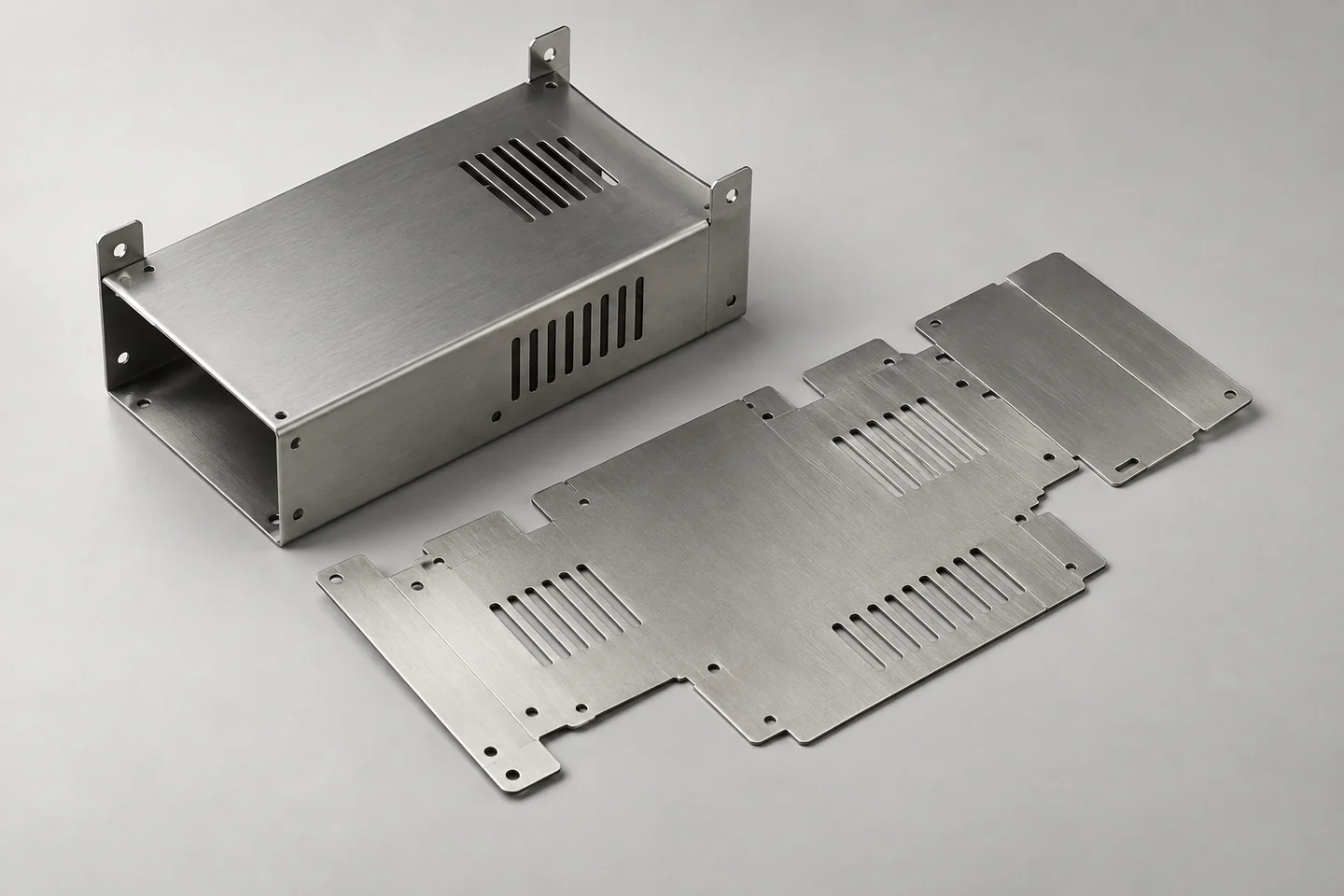
Generated sheet geometry concept, not an accepted customer part, measured process result or actual production lot.
01 / READINESS
A cut blank, formed part and coated assembly have different scopes. Identify what was actually accepted before repeating the order.
Name flat, formed and assembly files with units and revision. Resolve conflicts and preserve approved design changes.
Control grade, thickness, condition and any direction or surface requirement. State allowed alternatives explicitly.
Record cutting, edge work, forming, joining and finish included in the accepted state. Do not omit a secondary operation from the repeat brief.
02 / CHANGE RULES
A repeat label does not make different stock or processing equivalent. Link changes to important interfaces and evidence.
Record revised outlines, holes, bends or assembly geometry. Identify which earlier sample checks remain applicable.
Review grade, thickness or supplied-condition changes for forming, joining, finish and functional effects.
A revised cutting, forming, joining or coating sequence can affect references and final fit. State who approves the altered scope.
List quantities by part, revision and surface state. Separate forecasts from confirmed deliveries and define required identification.
03 / RELEASE STAGES
Sample, first production and repeat lot checks serve different purposes. Agree the scope rather than assuming one approval covers all future work.
| Stage | Question | Record |
|---|---|---|
| Development | Does geometry, fit or appearance meet intent? | Represented stock and processing. |
| Initial production | Is the offered final configuration accepted? | Features, methods and approval owner. |
| Repeat lot | Does delivery match the controlled scope? | Identity, quantities and agreed selection. |
| Revised route | What evidence needs review after the change? | Decision and updated acceptance basis. |
04 / HANDOFFS
Different responsible operations may prepare the stock, form, join or finish the part. The proposal should connect their outputs.

Supplied stock reference; it does not verify this delivery grade, inventory or traceability scope.
Ask which operations and records each party provides. Do not infer universal in-house ownership from process imagery.
Define when dimensions, edges, appearance and assembly are checked after relevant work.
Specify linkage between part number, revision, stock and lot evidence where needed. Confirm available records and variant segregation.
Agree nonconformance, substitution and rework review. A delivery record must not silently waive an unapproved requirement.
05 / LOT EVIDENCE
All-piece checks and selected samples are distinct scopes. State features, quantities and methods alongside the final requirement.
| Area | Agree | Link |
|---|---|---|
| Dimensions | Formed/assembled datums and fits. | Final configuration and revision. |
| Edges and surface | Functional limits and appearance reference. | Completed operations. |
| Material | Grade/thickness and requested records. | Actual supply and delivery scope. |
| Quantity | Lot selection and variant checks. | Identity and packing record. |
06 / QUOTATION
Preparation, changes, finish and inspection assumptions can alter the offer. The quoted unit should represent the accepted delivery.
Send approved files, material and thickness, sample record, surface map, quantities, variants and destination. Identify target milestones separately from commitments.
Ask for setup, tooling or preparation changes, fabrication, secondary work, inspection, records and packing where relevant.
Confirm approval dependencies, responsible route, minimum quantities and schedule for the actual proposal. No universal capacity or timing is asserted.
07 / QUESTIONS
Control the stock, final geometry and acceptance together.
Only within its explicit scope. Confirm configuration, material, operations and any changes before release.
Review its effect on fit, forming, joining, finish and earlier evidence before acceptance.
No default all-piece scope is promised. Agree features, quantities, methods and records.
No. Route, stock, quantities, secondary work and approvals determine the actual offer.
Approved files, stock, sample record, quantities/variants, final surface state, acceptance, identity, packing and destination.
PREPARE THE NEXT DECISION
Include grade/thickness, governing files, sample record, variants and quantities, formed or assembly scope, finishing, inspection, identification, packaging and destination.
sales@keepwinco.comAn enquiry starts a team review. Material, fit, quantity, schedule, operation responsibility and supporting records are confirmed in the proposal; this form does not create an order or an instant price.
Start with what you know. Review your details before sending; no account needed.
Start parts inquiry →Your project is saved securely only when submission succeeds.
General material context only; external references do not certify a finished KeepWin product.
Protolabs - sheet project and processing context ↗