
Refrigerant charging by pressure alone is often incorrect because pressure describes an operating condition—not the total amount of refrigerant inside a system.
The same air conditioner can show different pressures as indoor load, outdoor temperature, airflow, and operating capacity change. Conversely, similar pressure readings can occur in systems with different charge levels or different faults.
That makes “add refrigerant until the gauge looks normal” an unreliable approach. It can leave an actual undercharge unresolved, hide an airflow problem, or turn a correctly charged system into an overcharged one.
Pressure remains an essential diagnostic measurement. The mistake is treating it as a complete charging method without the temperatures, operating conditions, and manufacturer instructions needed to interpret it.
Pressure Is Not a Refrigerant Quantity Reading
A gauge measures pressure at its connection point. It does not directly measure pounds or ounces of refrigerant.
The distinction is especially clear when a system is off and has reached thermal equilibrium. For a pure refrigerant with liquid and vapor both present, saturation pressure is determined by temperature. Removing some refrigerant can leave essentially the same pressure as long as those conditions remain.
The Mobile Air Climate Systems Association’s explanation of refrigerant capacity uses this principle to show why matching a pressure-temperature chart does not establish a full charge.
Actual systems add complications: temperature differences, trapped refrigerant, blends, and contamination can affect interpretation. None turns static pressure into a reliable inventory measurement.
Therefore, “the standing pressure looks right” does not prove that an AC contains the required charge. It also cannot tell a technician exactly how much refrigerant to add.
Running Pressure Changes With Operating Conditions
Once the compressor starts, pressure reflects how the whole system is operating.
Indoor conditions affect the heat reaching the evaporator. Outdoor conditions affect the condenser’s ability to reject heat. Fans, metering devices, and compressor operation influence the resulting readings.
A pressure observed during a hot afternoon cannot automatically become a charging target for a mild morning. Nor should a reading taken during startup be treated as equivalent to one taken under the manufacturer’s stabilized test conditions.
Airflow can imitate a charge problem
Restricted indoor airflow can reduce the evaporator’s heat load and contribute to low suction pressure. Adding refrigerant does not correct a dirty filter, blocked coil, or improperly operating blower.
Outdoor airflow matters too. A condenser that cannot reject heat properly may produce elevated high-side pressure without excess refrigerant being the original cause.
Fieldpiece’s system-diagnostic guidance emphasizes checking airflow alongside refrigerant measurements because airflow problems can affect charge assessment.
The practical lesson is straightforward: establish suitable operating conditions before deciding that a gauge reading calls for refrigerant.
Superheat and Subcooling Add the Missing Temperature Information
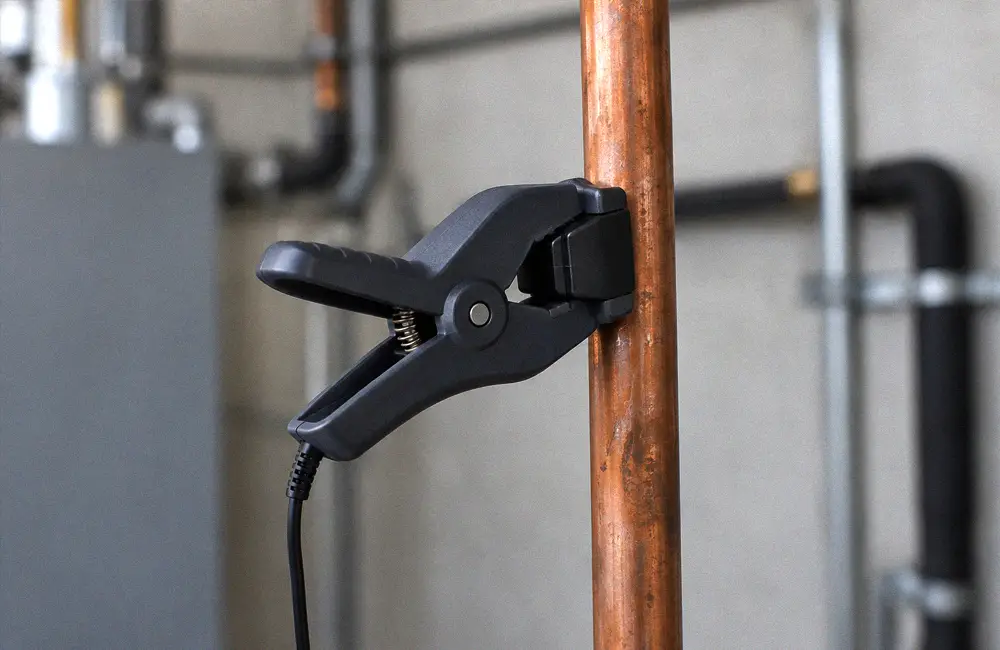
Pressure becomes much more useful when paired with a measured refrigerant-line temperature.
A pressure-temperature chart or correctly configured instrument supplies the appropriate saturation temperature. Comparing that value with the actual line temperature helps describe the refrigerant’s condition at the measurement point.
Superheat
Superheat is the vapor temperature above its saturation temperature at the corresponding pressure:
Superheat = measured vapor-line temperature − saturation temperature
Subcooling
Subcooling is the amount by which liquid temperature is below its saturation temperature at the corresponding pressure:
Subcooling = saturation temperature − measured liquid-line temperature
The Fieldpiece superheat and subcooling manual explains these relationships and emphasizes that equipment-manufacturer instructions take priority over generic examples.
Neither measurement independently proves that every other component is working correctly. Both are diagnostic information that must be interpreted in context.
A simple example: identical pressure, different superheat
Suppose two measurements correspond to a saturation temperature of 40°F.
- With a vapor-line temperature of 50°F, calculated superheat is 10°F.
- With a vapor-line temperature of 70°F, calculated superheat is 30°F.
The pressure is identical, but the refrigerant conditions are not.
These are arithmetic examples, not recommended charging targets. Whether either result is acceptable depends on the equipment, measurement location, load, and applicable procedure.
Without the temperature measurement, the technician would miss that difference entirely.
The Correct Charging Method Depends on the Equipment
There is no single method that applies unchanged to every residential AC, heat pump, ductless system, or refrigeration circuit.
The metering device matters, but it is not the only consideration. Factory charge assumptions, piping configuration, controls, and manufacturer-defined test conditions also matter.| System or situation | Common charging basis | Important qualification |
|---|---|---|
| Conventional fixed-orifice AC | Manufacturer’s target-superheat procedure | Requires suitable airflow and specified indoor/outdoor conditions. |
| Conventional TXV-equipped AC | Manufacturer’s subcooling procedure | Use the equipment-specific target, not a universal value. |
| Fully recovered and evacuated circuit | Specified charge weighed into the system | Include applicable piping and configuration adjustments. |
| Conditions outside the charging chart | Manufacturer-approved alternative procedure | Do not improvise a pressure target. |
This overview follows the conventional-system distinctions in Fieldpiece’s charging guidance and the equipment-specific weighing and operating-condition requirements illustrated in Carrier’s 38C installation manual. It is not a replacement for the manual covering the actual installation.
A TXV regulates refrigerant feed to control superheat. That is why a reasonable superheat reading alone should not be interpreted as confirmation of the correct total charge.
For inverter-driven or electronically controlled systems, do not assume that a conventional fixed-speed charging rule applies. Check the required service mode, charge calculation, and verification procedure. An electronic expansion valve does not, by itself, establish a universal subcooling target.
Charging by Weight Also Requires Context
A scale measures refrigerant transferred. It does not automatically establish how much refrigerant was already inside the equipment.
This distinction matters during partial-charge service. Adding the full nameplate amount to a system that still contains an unknown quantity can substantially overcharge it.
Similarly, the factory charge may cover a defined piping arrangement rather than every possible installation. Applicable adjustments must come from the equipment documentation—not a universal ounces-per-foot rule.
A clear service record should distinguish among:
- The factory charge.
- The calculated total charge for the installation.
- Refrigerant recovered.
- Refrigerant added.
- The final verification measurements.
When the existing charge cannot be established reliably, the technician should follow the manufacturer’s procedure for resolving that uncertainty. A scale reading and a pressure reading answer different questions; neither makes the other unnecessary.
Selecting the Wrong Refrigerant Data Creates Another Error
Even accurate instruments can produce misleading calculations when configured incorrectly.
The saturation temperature must correspond to the refrigerant actually specified for the system. A familiar gauge scale is not interchangeable with another refrigerant’s pressure-temperature relationship.
For blends with meaningful temperature glide, the selected saturation reference also matters. Schneider Electric’s pressure-temperature chart guidance distinguishes the saturated-vapor, or dew-point, reference from the saturated-liquid, or bubble-point, reference.
Use the appropriate dew-point value for superheat and bubble-point value for subcooling, following the equipment and instrument instructions.
This is another reason that a remembered pressure target is insufficient. It omits both refrigerant identity and the thermodynamic condition being evaluated.
Poor Temperature Measurements Can Undermine the Diagnosis
Adding a temperature probe does not guarantee a correct result.
A poorly seated sensor, unsuitable measurement location, or interference from the surrounding environment can distort the reading. Pressure and temperature measurements must also represent corresponding locations, with pressure drop considered where relevant.
Fieldpiece’s discussion of pipe-temperature accuracy identifies contact condition, surface contamination, calibration, and ambient interference as potential sources of error.
For reliable assessment, technicians should verify instrument setup, refrigerant selection, sensor contact, and manufacturer-specified measurement locations.
Digital tools can calculate quickly, but they cannot correct a wrong input automatically. A precise-looking number is not necessarily an accurate one.
A Better Approach to Refrigerant Charging
Charging should follow diagnosis, not replace it.
A qualified HVAC technician with the appropriate certification should first identify the equipment and its required refrigerant, then determine whether the complaint actually points to a charge problem.
A sound service approach includes:
- Review the correct documentation. Confirm the matched equipment, metering device, charge requirements, and approved test conditions.
- Check basic operation. Assess airflow, coil condition, fans, controls, and other faults that could distort refrigerant measurements.
- Investigate an apparent shortage. Establish why refrigerant may be missing rather than repeatedly topping off the system.
- Use the prescribed charging method. Apply weight, superheat, subcooling, or a manufacturer-specific procedure as required.
- Verify and document the result. Record the operating conditions, refrigerant transferred, and relevant final measurements.
The goal is not simply to make the gauges look familiar. It is to restore the specified charge and confirm that the equipment operates correctly.
What This Means for R410A Service
An R410A system does not have one universal “correct charging pressure.”
The refrigerant designation determines which refrigerant data to use. The equipment determines the required charge and the procedure for checking it.
For an installation specified to use R410A, Refrigerant Centers’ R410A refrigerant in a 25 lb cylinder is a relevant supply option after a technician confirms that additional refrigerant is needed. Cylinder size is a purchasing quantity—not a system-charge instruction.
When planning service materials, the Air Conditioning & Heat Pumps collection helps organize available options by application. Contractors handling different equipment types can also browse all refrigerants, while matching each selection to the equipment specification.
Neither a similar operating pressure nor placement in the same product category establishes compatibility. Do not mix refrigerants or select a substitute to make the gauges match an expected reading.
Frequently Asked Questions
Can normal pressures hide an incorrect charge?
Yes. A pressure reading can appear plausible without establishing the correct charge. Temperatures, load, airflow, equipment design, and the approved charging procedure provide the missing context.
Does low suction pressure always mean low refrigerant?
No. Low airflow, low evaporator load, and refrigerant-feed restrictions are among the other possibilities. Adding refrigerant without distinguishing these causes can introduce a second problem.
Is subcooling alone enough for every air conditioner?
No. Subcooling is commonly used for conventional TXV-equipped AC systems, but it is not a universal charging method. The equipment instructions determine its role and acceptable conditions.
Can I use a pressure chart to determine how many pounds to add?
No. A pressure-temperature chart relates saturation conditions. It does not convert a pressure reading into the missing refrigerant mass.
Are pressure-based charging charts ever valid?
Yes—when the manufacturer supplies a chart for the exact equipment and specifies the required temperatures, airflow, mode, and other conditions. Following that complete procedure is different from charging to pressure alone.
Can cold supply air confirm the charge?
Not by itself. Cooling is an important performance observation, but it does not establish the refrigerant inventory or rule out other operating problems.
Conclusion
Pressure is a valuable part of refrigerant diagnosis, but it is not a refrigerant quantity measurement.
Accurate charging combines the equipment’s instructions with appropriate operating conditions, reliable temperature measurements, and the prescribed charging method. When pressure is treated as one piece of evidence instead of the entire answer, technicians are better positioned to correct the original problem without creating another.