Moisture can reduce cooling performance, interfere with refrigerant flow, and contribute to damage inside an air-conditioning system. Its effects range from intermittent restrictions at cold metering components to chemical deterioration of compressor lubricant.
However, moisture does not simply make refrigerant “weaker.” The more useful explanation is that water disrupts the conditions a refrigeration circuit needs to operate reliably: controlled flow, suitable lubrication, clean internal surfaces, and stable refrigerant delivery.
A contaminated system may still cool for a while. It may even seem normal during a short inspection. That does not establish that the refrigerant circuit is dry or that its lubricant remains in good condition.
Understanding the difference between moisture contamination, an incorrect charge, and an airflow problem helps prevent unnecessary refrigerant additions—and repairs that fail to address the original cause.
What Does Moisture Contamination Actually Mean?
Moisture contamination means unwanted water is present inside the sealed refrigerant circuit—not simply on the outside of a cold pipe.
Water may be present as vapor, dissolved in refrigerant or oil, or as free water when conditions permit. Visible droplets are not required for contamination to matter.
This distinction is important because an air conditioner normally removes humidity from indoor air. Condensate forming on the outside of the evaporator and draining into a pan is expected. That water is separate from the refrigerant circulating inside the tubing.
A wet drain pan, sweating suction line, or humid mechanical room therefore does not, by itself, prove that water has entered the refrigeration circuit.
How Does Water Get Into a Refrigerant System?
The most important question is often what happened before the symptoms appeared.
Was the circuit opened for a compressor replacement? Were line ends left uncapped? Was the system evacuated and tested before charging? Were the lubricant and service equipment protected from ambient air?
Copeland’s installation and service guidance explains that exposure to the atmosphere can introduce moisture and that prolonged exposure may create a moisture load beyond a filter-drier’s available capacity.
Potential entry routes include:
- Open tubing or components during installation and repair.
- Inadequate dehydration before refrigerant is introduced.
- Lubricant exposed to humid air.
- Contaminated service equipment or refrigerant.
- A leak that allows humid air inward when internal pressure falls below atmospheric pressure.
A refrigerant leak does not automatically mean water is being sucked inside. When pressure at the leak remains above atmospheric pressure, the immediate flow is generally outward.
Service history helps a technician evaluate the likelihood of contamination. It is not a substitute for testing.
Moisture Can Interrupt Refrigerant Flow
One of the clearest performance problems occurs when water freezes at a sufficiently cold restriction.
An expansion valve or capillary tube depends on a small, controlled passage. Ice forming at that passage can reduce refrigerant delivery to the evaporator. The result may be a starved evaporator and a loss of cooling capacity.
Danfoss’s explanation of filter-driers and sight glasses identifies expansion-valve icing as a possible consequence of excessive moisture when evaporating temperatures reach freezing conditions.
The restriction may change as the component cools and warms. That creates a possible pattern in which cooling deteriorates during operation, improves after a shutdown, and then deteriorates again.
This is a diagnostic possibility—not proof of moisture. Mechanical restrictions and control problems can also produce changing refrigerant flow.
Nor should every frozen AC coil be blamed on internal water contamination. Ice covering the outside of an evaporator is a different observation from an ice blockage inside a metering passage.
Moisture Also Changes the Condition of Compressor Oil
The problem is not limited to refrigerant flow.
Polyolester oil, commonly called POE oil, is hygroscopic: it absorbs moisture from its surroundings. Water can also participate in chemical reactions that degrade the lubricant.
The Danfoss PSH application guidelines explain that POE holds moisture more tightly than mineral oil and can react with water to form acids and alcohols.
This reaction is called hydrolysis. It is different from a temporary ice blockage: removing the immediate flow restriction does not necessarily reverse chemical damage that has already occurred.
That is why “the AC is cooling again” is not a complete cleanup assessment. Refrigerant condition, oil condition, and component condition are related, but they are not the same thing.
A technician may need to evaluate the lubricant as well as the refrigerant, particularly after significant exposure or a compressor failure. An acid test answers a different question from a moisture test; neither should automatically stand in for the other.
Why the Symptoms Can Be Misleading
Moisture contamination does not have one universal gauge-pressure signature.
A flow restriction may affect suction pressure and superheat. Chemical contamination may initially produce no obvious comfort complaint. Air introduced during the same service event can create a separate problem.
Treating all these conditions as “bad refrigerant” makes diagnosis less precise.| Observation | Possible significance | What it does not prove |
|---|---|---|
| Cooling becomes intermittent | A changing restriction deserves investigation. | Moisture is the only possible cause. |
| Moisture indicator reads wet | Interpret using the indicator’s specified conditions. | A universal water concentration applies. |
| Bubbles appear in a sight glass | Liquid delivery may be incomplete. | The bubbles are water. |
| Pressure rises during a vacuum hold | Consider moisture, outgassing, leaks, and the test setup. | The system needs more refrigerant. |
The distinctions above draw on Danfoss’s sight-glass guidance and Fieldpiece’s vacuum-gauge guidance; they are diagnostic considerations, not pass/fail specifications.
How Technicians Check for Moisture
A useful investigation combines the service history with operating measurements and appropriate contamination checks.
Read the correct moisture indicator
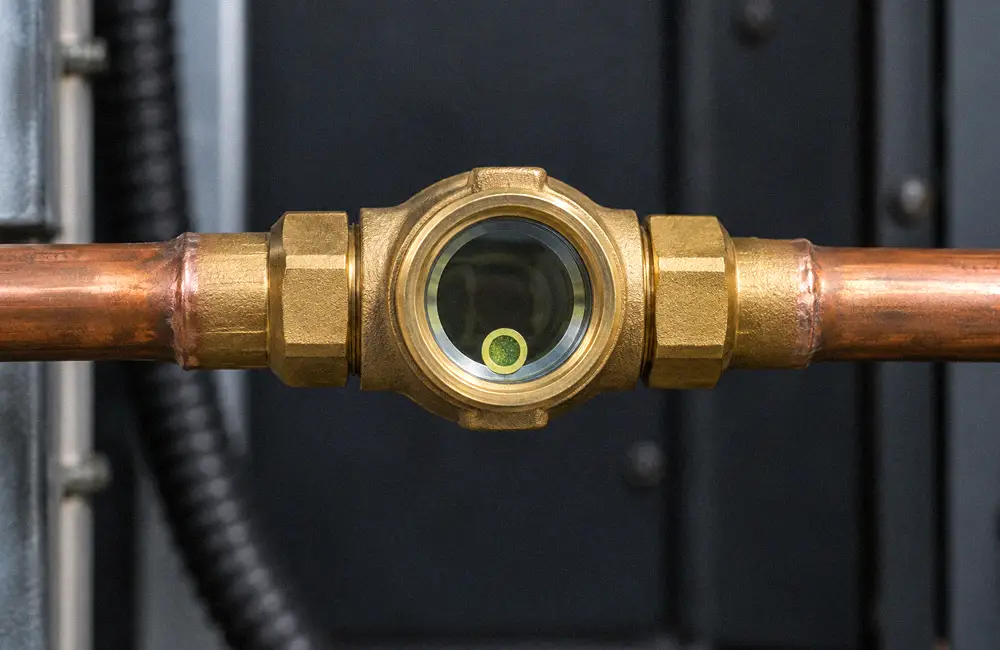
Some liquid-line sight glasses contain a color-changing moisture indicator. The viewing window and the moisture-sensitive element perform different functions: seeing bubbles is not the same as receiving a wet indication.
The Danfoss SGN specifications list different moisture-indication thresholds for different refrigerants and temperatures. A color interpretation therefore needs the correct product instructions and operating context.
A moisture indicator also does not provide a complete assessment of compressor wear or oil degradation.
Evaluate the whole operating condition
Before concluding that contamination is responsible, the technician should assess airflow, coil condition, load, refrigerant charge, metering-device operation, and relevant temperature measurements.
The practical question is whether the evidence fits a moisture-related problem better than competing explanations.
For example, a complaint that began immediately after an open-circuit repair warrants different follow-up questions from a complaint that began after an air filter became blocked.
Use additional testing when necessary
Where field indicators and operating checks leave uncertainty, appropriate refrigerant or lubricant analysis may be needed.
Ask what was measured, which sample was tested, and what limit applies. “The refrigerant looks clean” is not equivalent to a documented moisture result.
Can a Filter-Drier Solve the Problem?
A correctly selected filter-drier is an important part of moisture control, but its capacity is finite.
Parker Sporlan’s contamination-control guidance recommends renewing its filter-drier protection when a system is opened for service because neither the existing remaining capacity nor the contamination introduced during repair can be assumed.
The same guidance identifies water, acids, sludge, and deposits as threats to system components and metering-device operation.
That does not mean installing any drier will restore any contaminated system. Selection must account for the equipment, refrigerant, required contaminant-removal capability, and manufacturer instructions.
Heavy contamination or compressor damage may require a broader cleanup procedure. A new drier cannot undo damaged bearings, and replacing refrigerant alone does not necessarily remove contamination retained elsewhere in the circuit.
What Proper Moisture Removal Involves
Moisture-related service should be performed by a qualified HVAC technician with the appropriate certification.
The work generally follows four objectives:
- Stop further contamination. Identify and correct the entry route, including leaks or poor handling practices.
- Assess what requires cleanup or replacement. Evaluate the refrigerant, lubricant, drier, and affected components.
- Dehydrate and verify the circuit. Follow the equipment manufacturer’s evacuation and standing-vacuum requirements.
- Restore and verify operation. Use the specified refrigerant and charging procedure, then confirm performance.
Evacuation is not simply running a pump for a set number of minutes. The system’s condition and the vacuum measurement matter.
A low reading near the pump does not automatically establish that the entire circuit has reached the required condition. Likewise, a brief low reading while pumping is different from a satisfactory isolation test.
There is no universal evacuation duration that proves every system dry. The technician should document the applicable target and hold criteria, rather than rely only on elapsed time.
Replacing refrigerant, drying the circuit, and correcting oil contamination are separate tasks that may all be necessary.
What This Means for an R410A System
R410A service illustrates why refrigerant selection and moisture control belong in the same conversation.
Copeland’s R410A compressor guidance emphasizes limiting atmospheric exposure because POE oil absorbs moisture more readily than mineral oil.
For equipment specified to use R410A, restoring the correct charge after an approved cleanup still requires R410A—not a different refrigerant chosen because the original charge was contaminated.
When replacement refrigerant is required, Refrigerant Centers’ R410A refrigerant in a 25 lb cylinder is a relevant service-material option for compatible equipment. It is not a drying treatment.
For other equipment, the Air Conditioning & Heat Pumps collection provides a browsing starting point. Product categories do not establish interchangeability; the equipment specifications remain controlling.
Frequently Asked Questions
Does moisture always cause high refrigerant pressure?
No. Moisture has no single pressure signature. Its effects depend on the contamination level and whether it produces a restriction, chemical deterioration, or another problem. Air contamination is a separate consideration.
Can adding fresh refrigerant remove moisture?
No. Adding refrigerant is not a dehydration procedure. It can leave the contamination unresolved and create an incorrect charge if the system was not actually undercharged.
Can moisture disappear when the AC shuts off?
An ice restriction may thaw, allowing flow to improve temporarily. That does not mean the water has left the sealed circuit or that existing chemical contamination has been corrected.
Is water dripping from the AC evidence of contaminated refrigerant?
No. Condensate normally forms outside the evaporator tubing. Drainage problems and internal refrigerant contamination require different investigations.
How long can a contaminated system keep running?
There is no reliable universal timeline. Continued cooling does not establish that operation is harmless. Recurring loss of capacity, abnormal operation, or a confirmed wet indication warrants professional investigation.
Conclusion
Moisture changes refrigeration-system performance by interfering with flow and contributing to lubricant and component deterioration—not merely by reducing refrigerant “strength.”
The right response is to identify the contamination source, evaluate its consequences, complete the required cleanup, and verify the result before returning the equipment to service.
If that work requires replacement refrigerant, browse all refrigerants at Refrigerant Centers after confirming the exact equipment requirement with your technician.