A slightly overcharged air conditioner may continue producing cool air, especially during mild weather. However, the extra refrigerant does not provide extra cooling. It can increase condensing pressure, raise compressor workload, reduce efficiency, and interfere with the system’s ability to manage liquid refrigerant.
The severity depends on how much excess refrigerant is present, the metering device, indoor airflow, outdoor temperature, condenser condition, and system design. A small charging error may produce subtle symptoms, while a larger overcharge can trip safety controls or contribute to compressor damage.
An overcharge cannot be confirmed from one pressure reading alone. Proper diagnosis requires pressure, temperature, airflow, electrical, and manufacturer charging data.
What Does “Slightly Overcharged” Mean?
An AC is overcharged when it contains more refrigerant than the manufacturer-specified amount or more than operating conditions require under the approved charging procedure.
There is no universal number that defines a “slight” overcharge. A few extra ounces may be meaningful in a compact system, while a larger commercial circuit may have a different tolerance. Line-set length and approved field-charge adjustments also matter.
The correct charge may be established using:
- The factory charge listed on the equipment nameplate
- Additional charge calculations for the installed line set
- Manufacturer subcooling or superheat procedures
- A weighed refrigerant charge after complete recovery and evacuation
- Approved charging charts for the current indoor and outdoor conditions
A system should not be judged by whether the service-gauge needles look “close enough.”
What Happens Inside an Overcharged AC?
During normal operation, the condenser receives hot, high-pressure refrigerant vapor from the compressor. It rejects heat outdoors and converts that vapor into liquid.
When the system contains too much refrigerant, more of the condenser may become occupied by liquid. This reduces the effective space available for condensing vapor and can raise condensing temperature and high-side pressure.
The compressor must then pump against greater discharge pressure. That can increase electrical demand and compressor temperature while reducing overall operating efficiency.
Excess charge may also increase subcooling because liquid refrigerant remains in the condenser longer. Depending on the metering device and load, the evaporator may receive more refrigerant than it can completely boil into vapor. The U.S. Department of Energy notes that incorrect charge affects both capacity and efficiency and that an overcharged system can create conditions in which refrigerant does not completely evaporate before returning toward the compressor. DOE Air Conditioner Diagnostics Guideline
A small overcharge does not guarantee immediate compressor failure. It does, however, move the system away from its intended operating condition and reduce its margin for handling high outdoor temperatures, airflow problems, or dirty coils.
Common Symptoms of an Overcharged Air Conditioner
| Possible symptom | Why it may occur | Important limitation |
|---|---|---|
| High head or condensing pressure | Excess liquid occupies condenser volume and raises the compressor’s discharge pressure. | Dirty coils, blocked airflow, noncondensable gases, and high outdoor temperature can produce similar readings. |
| Higher-than-target subcooling | Additional liquid refrigerant accumulates in the condenser. | The correct target is equipment- and condition-specific. |
| Elevated compressor amperage | The compressor may work harder against increased discharge pressure. | Voltage problems and mechanical faults must also be checked. |
| High-pressure safety trips | System pressure exceeds the control’s allowable operating range. | A failed condenser fan or airflow obstruction can cause the same shutdown. |
| Reduced or inconsistent cooling | The refrigeration cycle operates outside its intended balance. | Poor cooling alone does not distinguish overcharge from undercharge. |
| Compressor noise or overheating | High compression ratios or liquid returning to the compressor may create stress. | Shut the system down if severe noise, repeated trips, or overheating occurs. |
Source note: This table summarizes diagnostic principles from the DOE Air Conditioner Diagnostics Guideline and a Daikin service manual. The Daikin manual identifies excessive head pressure as a common overcharge indicator while warning that other system conditions can cause the same symptom.
TXV and Fixed-Orifice Systems May React Differently
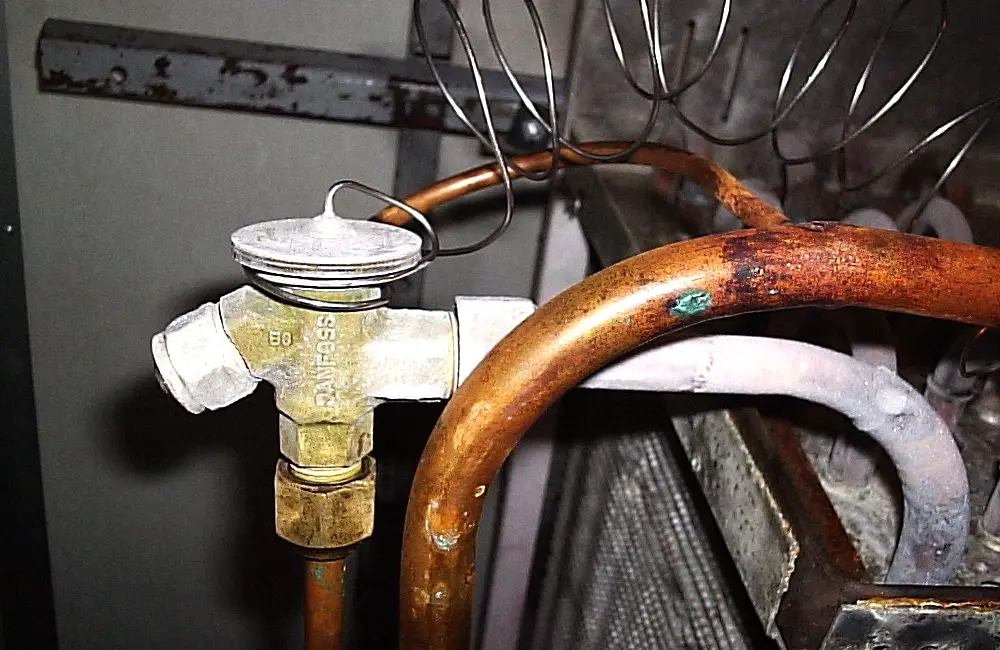
The metering device controls refrigerant flow into the evaporator, so it affects how an overcharge appears during testing.
Systems With a TXV
A thermostatic expansion valve, or TXV, adjusts refrigerant flow in response to evaporator outlet conditions. It may compensate for a modest charge error and maintain apparently normal superheat for a time.
Consequently, the AC may still cool while showing elevated subcooling and increased high-side pressure. That ability to compensate can make a small overcharge less obvious, but it does not make the extra refrigerant beneficial.
Fixed-Orifice and Capillary-Tube Systems
A fixed-orifice device cannot actively regulate flow. Its refrigerant feed changes according to the pressure difference across the restriction.
These systems may show a more noticeable change in superheat as charge and load change. Under unfavorable conditions, excessive refrigerant can increase the possibility of liquid returning toward the compressor.
The DOE warns that metering-device behavior, airflow, environmental conditions, and multiple simultaneous faults can all affect charge diagnosis. Manufacturer instructions therefore take priority over generic pressure or temperature targets. DOE diagnostic guidance
Why High Pressure Alone Does Not Prove Overcharge
High head pressure is an important clue, but it is not a complete diagnosis. Similar readings can be caused by:
- A dirty outdoor condenser coil
- A failed or slow condenser fan
- Restricted airflow around the outdoor unit
- Extremely high outdoor temperature
- Noncondensable gases inside the circuit
- Incorrect indoor airflow
- A refrigerant-line or metering-device restriction
- Faulty sensors, gauges, or test procedures
The technician should verify coil cleanliness, fan operation, airflow, operating conditions, temperature measurements, and equipment specifications before removing refrigerant.
Pressure observed after the compressor stops is even less useful for determining charge quantity. Refrigerant continues moving and pressures begin equalizing after shutdown. Ambient temperature also changes the static pressure. Our guide to why refrigerant pressure rises after an AC shuts off explains why an off-cycle pressure reading cannot confirm an overcharge.
Can a Slight Overcharge Damage the Compressor?
It can contribute to damage, but the risk is not identical in every system.
The immediate effect may be limited to higher operating pressure and reduced efficiency. If conditions allow liquid refrigerant to reach the compressor, however, the consequences become more serious.
A compressor is designed primarily to compress vapor. Liquid refrigerant can dilute the lubricating oil, reduce lubrication, and cause mechanical stress. A sufficiently large amount of liquid entering the compression chamber can cause liquid slugging.
Copeland explains that refrigerant floodback can dilute compressor oil and increase wear, while severe slugging can damage valves, gaskets, and other internal parts. Copeland liquid refrigerant control bulletin
This is a potential progression—not proof that every slightly overcharged system is already experiencing liquid slugging.
Is It Safe to Keep Running the AC?
Do not continue operating the system if it:
- Repeatedly trips a high-pressure switch or circuit breaker
- Makes knocking, hammering, or unusually harsh compressor noises
- Produces a burning smell
- Overheats or shuts down repeatedly
- Provides very little cooling despite continuous operation
Turn it off and arrange professional service.
If the AC still cools and shows no severe symptoms, a suspected minor overcharge may not require an emergency shutdown. It should nevertheless be inspected promptly, particularly if the problem began immediately after refrigerant was added.
Running an incorrectly charged system for an extended period can waste electricity and increase compressor stress. The same principle applies in the opposite direction: operating an AC with low refrigerant can also reduce performance and harm equipment.
Do Not Bleed Refrigerant Into the Air
A homeowner should never open a service valve or press a valve core to “let a little refrigerant out.” Besides being inaccurate and potentially dangerous, that releases refrigerant instead of recovering it properly.
In the United States, attaching gauges and adding or removing refrigerant from stationary air-conditioning equipment are generally tasks for technicians certified under EPA Section 608. EPA technician certification requirements
Federal rules also prohibit intentionally venting regulated refrigerants and their substitutes during servicing, except for narrowly defined de minimis releases associated with good-faith recovery and service practices. EPA refrigerant management guidance
How a Technician Corrects an Overcharge
A qualified technician should first confirm that excess charge is actually the cause. The usual process includes:
- Confirming the refrigerant type and equipment specifications.
- Checking filters, indoor airflow, coils, fans, and obvious restrictions.
- Measuring suction and discharge pressures under appropriate conditions.
- Measuring line temperatures to calculate superheat and subcooling.
- Comparing the results with the manufacturer’s charging procedure.
- Recovering excess refrigerant into approved recovery equipment.
- Rechecking pressures, temperatures, amperage, and cooling performance.
If contamination, mixed refrigerants, or noncondensable gases are suspected, simply removing a few ounces may not solve the problem. The system may require complete recovery, evacuation, and a weighed recharge.
Once the equipment has been diagnosed and its correct refrigerant identified, qualified buyers can browse Refrigerant Centers’ air-conditioning and heat-pump refrigerants or the complete refrigerant collection. These collection pages are purchasing resources—not compatibility charts. Refrigerant must be selected from the equipment label and manufacturer documentation, never by cylinder color or pressure alone.
Frequently Asked Questions
Will an overcharged AC still blow cold air?
Yes. A modestly overcharged system may continue blowing cold air, especially under light or moderate load. Cooling at the vents does not prove the charge is correct. Efficiency, high-side pressure, subcooling, and compressor amperage may already be abnormal.
Does more refrigerant make an AC colder?
No. An AC is engineered for a specific refrigerant quantity and operating range. Adding refrigerant beyond the correct charge can reduce heat-transfer effectiveness and increase compressor workload.
What pressure indicates an overcharged AC?
There is no universal pressure that proves overcharge. Normal pressure depends on refrigerant type, indoor and outdoor temperature, airflow, equipment design, and load. Diagnosis should combine pressure readings with superheat, subcooling, amperage, airflow, and manufacturer data.
Does an overcharged AC cause the evaporator to freeze?
Overcharge alone is not the most common explanation for a frozen evaporator. Low airflow, a dirty filter, blower problems, metering faults, and low refrigerant can also cause freezing. The entire system must be evaluated before refrigerant is added or removed.
Can overcharging cause high subcooling?
Yes. Higher-than-target subcooling is a common overcharge indicator, particularly on systems charged according to a manufacturer-specified subcooling procedure. However, subcooling must be measured under the required operating conditions.
Can a TXV hide an overcharge?
A TXV can compensate for changing load and refrigerant flow, potentially making a modest overcharge less obvious. Superheat may look reasonable while subcooling and high-side pressure are elevated. It cannot compensate indefinitely for every degree of overcharge.
How is excess refrigerant removed?
A certified technician connects approved recovery equipment and transfers refrigerant into a recovery cylinder. The technician then verifies the corrected charge using the manufacturer’s specified procedure. Refrigerant should never be intentionally released into the atmosphere.
Conclusion
A slightly overcharged AC may appear to operate normally, but extra refrigerant offers no cooling advantage. It can raise head pressure, increase energy use, strain the compressor, and reduce the system’s ability to handle difficult operating conditions.
Because several faults can imitate an overcharge, refrigerant should not be removed based on pressure alone. A qualified technician should verify airflow and equipment condition, apply the manufacturer’s charging method, recover any excess refrigerant, and confirm normal operation.